









By Dook International | Updated August 2026 | 13 min read | Sources: NPCI International (NIPL), RBI, PhonePe, Google Pay, BHIM
Article Summary
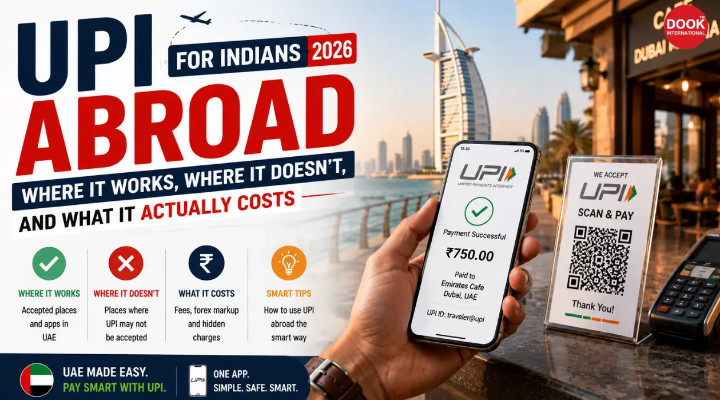
UPI now works in 10 countries as of July 2026. But there are three things most travel articles don't tell you: merchant acceptance in UPI-listed countries varies wildly (from near-universal in Singapore to patchy in Qatar); all international UPI transactions carry a hidden forex markup of 1–3.5% that the apps don't show upfront; and you must activate international UPI before leaving India or it won't work at all. This is the honest, complete guide.
UPI Abroad 2026: Quick Snapshot
| Countries live as of August 2026 | 10: UAE, Singapore, France, Mauritius, Nepal, Bhutan, Qatar, Sri Lanka, Cambodia, Greece |
| Most recent addition | Greece — live from 30 June 2026 via Eurobank x NPCI International partnership |
| Apps that support international UPI | BHIM, PhonePe, Google Pay, Paytm (varies by country and bank) |
| WhatsApp Pay international? | NO — WhatsApp Pay works for INR transfers within India only |
| Cost of using UPI abroad | App fee: zero. Hidden cost: 1–3.5% forex markup from your bank on currency conversion |
| Must activate before travel? | YES — international UPI must be enabled in your app settings before leaving India |
| Does it replace cash entirely? | No — merchant acceptance varies significantly even in listed countries |
| Daily transaction limit | Varies by bank — typically Rs 1 lakh per day for PhonePe and Google Pay |
The moment that defines UPI abroad is simple: you are standing at a café in Paris, the server slides over the card machine, and you wonder if scanning a QR code with your PhonePe will actually work — or whether you are about to hold up a queue while rummaging for euros.
India's Unified Payments Interface has become one of the world's most significant payment infrastructure stories. NPCI's own data places UPI at over 50% of the world's real-time digital transactions by volume. And as of August 2026, the international footprint has reached 10 countries — with Greece becoming the most recent addition on June 30 2026.
But the gap between 'UPI is accepted in France' and 'I can reliably pay everywhere in Paris with my phone' is significant — and most travel articles paper over it. This guide gives Indian travellers the honest, practical picture: which countries, which apps, what it costs, what activation steps are needed before departure, and where it still fails in 2026.
If you are planning payment strategy for a trip, this article works best alongside Dook's guide to the best forex cards for Indians travelling abroad — which covers the complementary tool that fills UPI's gaps, and Dook's cash limits abroad guide for understanding how much physical currency to carry alongside your digital payment options.
How UPI International Actually Works — The Mechanism Explained
Understanding how UPI works internationally explains both its strengths and its limitations. When you scan a QR code abroad using your Indian UPI app:
| What Happens | Why It Matters | |
| 1 | You scan a QR code at a participating merchant | The merchant must display a UPI-linked QR code — not just any QR. Standard Visa/Mastercard QR codes don't work. |
| 2 | Your UPI app sends the payment request through NPCI International (NIPL) to the local payment network | NIPL is the international arm of NPCI. It has bilateral agreements with central banks or payment networks in each partner country. |
| 3 | The local network processes the payment in local currency | Your Indian bank account is debited in Indian Rupees, converted at the day's exchange rate. |
| 4 | A forex markup is applied by your bank on the conversion | This 1–3.5% markup is not shown separately in the app — it is embedded in the exchange rate. This is where the hidden cost lives. |
| 5 | You get confirmation in seconds | The experience is identical to paying in India — scan, authenticate with PIN, done. |
The Hidden Cost Nobody Shows You Upfront
The UPI app (PhonePe, Google Pay, BHIM) charges zero transaction fee for international payments. But your bank applies a forex markup of 1–3.5% over the mid-market exchange rate on the currency conversion. On a Rs 50,000 trip spend via UPI, this hidden markup costs Rs 500–1,750 — embedded invisibly in the exchange rate rather than shown as a separate line item. This is less than most international credit cards (2.5–4%), but more than a good zero-markup forex card (0–0.5%). The final INR amount is shown in the app before you confirm — always check it against Google's live exchange rate to estimate the effective markup your bank is applying.
The 10 Countries Where UPI Works Abroad in 2026 - Honest Merchant Reality Included
The official list and the practical reality at street level are not the same thing. Here is both — country by country.
| Country | Live Since | Integration Partner | Practical Merchant Coverage | Verdict |
| Singapore | 2023 | PayNow – PayNow bilateral link | Excellent — major malls, hawker centres, 7-Eleven, tourist areas. Works like India. | Best UPI abroad experience globally |
| UAE (Dubai, Abu Dhabi, more) | 2022 | Mashreq Bank, LuLu Exchange, others | Good — major malls, Indian-area shops, larger restaurants. Patchy at street kiosks. | Reliable for planned spend, carry some cash for souks |
| Bhutan | 2021 (Pioneer) | Royal Monetary Authority of Bhutan | Excellent — 60,000+ merchant outlets. Most tourist-facing shops accept it. | Virtually cashless travel possible |
| Nepal | 2024 | Banking partnerships | Good — Kathmandu and Pokhara tourist areas well-covered. | Reliable in cities, carry cash for rural areas |
| Sri Lanka | 2024 | NIPL x local banks | Moderate — Colombo and Kandy tourist areas. Limited outside cities. | Useful supplement, not a cash replacement |
| Mauritius | 2024 | MauCAS hub integration | Moderate — growing but merchant density still building. | Carry forex card or cash as primary |
| France | 2024 (1st European) | NIPL x European partners | Limited — specific tourist zones and Indian-friendly merchants. Not mainstream. | Paris tourist sites only — carry card for everywhere else |
| Qatar | 2024 | Local payment network | Patchy — Villaggio Mall and select Doha merchants. Network compatibility issues reported. | Success rate ~55% at listed merchants. Carry cash. |
| Cambodia | June 2026 | ACLEDA Bank x KHQR system | New — 4.5 million merchant locations announced in Phase 1. Phase 2 ongoing. | Phase 1 launched June 2026 — coverage building. Carry backup. |
| Greece | June 30 2026 (10th country) | Eurobank x NIPL partnership | New — tourist areas in Athens and major cities. Coverage building. | Very new — carry card for this trip, UPI as bonus |
Countries Where UPI Does NOT Work (2026)
Thailand: no NPCI International agreement yet despite being India's #1 outbound destination
Japan: NPCI-JCB trial announced April 2026 but not operational; do not rely on it
Malaysia: NPCI signed PayNet agreement but not live for retail QR payments as of August 2026
Indonesia (Bali): no retail UPI. Tourist-facing digital payments use GoPay, OVO, QRIS
USA, UK, Canada, Australia: no bilateral agreements; use international card or forex card
Europe (except France and Greece): Germany, Italy, Spain, Switzerland, Netherlands: no UPI
Turkey: no NPCI agreement
Vietnam: no UPI; major cash and local QR economy
UPI-Active Countries Mapped to Your Travel Destinations
Here is how UPI availability maps to Dook's most popular international tour destinations:
| Destination | UPI Status | Practical Recommendation |
| Dubai / UAE | LIVE — good coverage | Use UPI at malls, Indian-area restaurants. Carry Dook's recommended forex card for souks and street markets. |
| Singapore | LIVE — excellent coverage | UPI works reliably. Still carry SGD 50–100 for hawker stalls that are cash-only. |
| France (Paris) | LIVE — limited coverage | UPI at Eiffel Tower souvenir shops and selected Indian-area restaurants only. Card essential for everything else. |
| Greece | LIVE from June 30 2026 — new | Very new. Use as a bonus if you spot a UPI QR. Primary payment: card or euros. |
| Bali / Indonesia | NOT live | Cash (IDR or USD), card, or Bali e-VOA prepayment. No UPI. See Dook's Bali guide. |
| Thailand | NOT live | Cash (THB), card, or forex card. No UPI despite 60-day visa-free for Indians. |
| Cambodia | LIVE from June 2026 — building | Phase 1 with 4.5 million merchants. Carry USD cash as backup — Cambodia is still cash-heavy. |
| Sri Lanka | LIVE — moderate | UPI in Colombo and Kandy tourist zones. Carry LKR cash for smaller towns. |
| Mauritius / Seychelles | Mauritius: LIVE moderate. Seychelles: NOT live | Mauritius: UPI as supplement. Seychelles: forex card or card only. |
| Europe (Germany, Switzerland, Italy, Spain) | NOT live | Card, forex card, or euros essential. UPI has no presence in these countries. |
Which UPI Apps Work Internationally — And Which Don't
Not all UPI apps support international payments. The capability depends on both the app and your bank's international UPI activation. Here is the current picture:
| App | International UPI? | Countries Supported | Activation Required? |
| PhonePe | YES | Most NIPL partner countries | Enable 'International Payments' in app settings before travel |
| Google Pay | YES | Most NIPL partner countries | Enable international payments in settings; verify bank supports it |
| BHIM (NPCI Official) | YES — earliest supporter | All NIPL countries | International use enabled by default but verify before travel |
| Paytm | PARTIAL — varies by region | Selected countries only | Check in-app; Paytm's international UPI coverage is less comprehensive than PhonePe/GPay |
| WhatsApp Pay | NO | India only | WhatsApp Pay is India-only for INR domestic transfers. Cannot be used for international payments. |
| Amazon Pay | NO | India only | Domestic only. Not supported for international UPI. |
How to Activate International UPI Before Your Trip (Do This in India, Not at the Airport)
Step 1: Open your UPI app (PhonePe or Google Pay recommended).
Step 2: Go to Settings -> Profile or Account Settings -> International Payments.
Step 3: Enable international transactions. Some banks require OTP verification.
Step 4: Check your bank account's settings separately — some banks require you to enable international UPI independently in the banking app or at the branch.
Step 5: Do a test — check if the 'International' toggle shows as active.
Critical: Do this at least 2–3 days before departure. Attempting to activate at the airport or abroad with patchy connectivity causes verification failures that lock you out.
What UPI Abroad Actually Costs: The Honest Fee Breakdown
The single most misunderstood aspect of international UPI is the cost structure. Here is every layer, honestly:
| Fee Type | Amount | Who Charges It |
| App transaction fee (PhonePe, Google Pay, BHIM) | Zero — Rs 0 | No charge from the UPI app itself for international payments |
| Bank forex markup on currency conversion | 1% to 3.5% over mid-market exchange rate | Your Indian bank, embedded invisibly in the exchange rate shown in the app |
| Bank's international transfer/processing fee | Rs 0 to Rs 500+ per transaction (varies by bank) | Some banks add a flat fee on top of the forex markup — check your bank's schedule |
| Dynamic Currency Conversion (DCC) trap | Additional 2–5% if you accept | Some merchants offer to convert to INR at the point of sale. ALWAYS decline — accept payment in local currency and let your bank do the conversion. |
In practice: a Rs 5,000 equivalent purchase via UPI abroad costs you Rs 5,050–5,175 (at 1–3.5% markup). Compare this to a good zero-markup forex card (Rs 5,000 exact) or a standard credit card with a foreign transaction fee (Rs 5,125–5,200 typically). UPI is in the middle — better than a standard credit card but worse than a zero-markup forex card. See the full forex card comparison in Dook's best forex cards guide.
UPI One World: The Tourist Wallet Solution for Non-NRI International Travellers
UPI One World is a separate but related product worth knowing about. It is designed for foreign tourists visiting India — but it is also relevant for Indian travellers who prefer a pre-loaded wallet approach rather than linking a bank account.
• What it is: A prepaid UPI wallet issued to international visitors (and available to Indian travellers heading to NIPL partner countries through select issuing banks).
• How it works: You load a specific amount in Indian Rupees, which is converted to the destination currency. Payments are made via UPI QR code scan like a standard UPI transaction.
• Advantage: The exchange rate is fixed at loading time — you know your exact cost upfront, unlike standard UPI where the bank-set rate is applied at each transaction.
• Where to get it: Through authorised issuing banks — verify with your bank before travel. Activation requires passport and visa verification at the bank counter.
• Limitation: Available at select banks only, requires physical activation, and not as seamless as activating international UPI on PhonePe or Google Pay.
The Smart Indian Traveller's Digital Payment Strategy for 2026
No single payment method covers every situation abroad. Here is the layered approach that works across all Dook destination categories:
| Layer | What to Use and Why |
| Primary: Zero-markup forex card | Best for planned, larger spends — hotel supplements, restaurants, shops. 0% forex markup, accepted everywhere with a Visa/Mastercard terminal. See Dook's forex card guide for the best 2026 options. |
| Secondary: UPI (where available) | Best for small purchases, QR-code merchants, markets, and convenience purchases in the 10 UPI-active countries. Activate before travel. Accept local currency at the QR, never INR. |
| Emergency: International debit/credit card | Backup for when UPI QR is not available and forex card terminal fails. Be aware of 2.5–4% foreign transaction fees on most Indian credit cards. |
| Always: Local cash | A destination-appropriate minimum — Rs 3,000–5,000 equivalent — for cash-only situations. See Dook's guide on how much cash to carry abroad for country-specific amounts and RBI limits. |
| Never rely on: WhatsApp Pay, Amazon Pay, Paytm (fully) | These are limited or entirely domestic. Do not assume they work internationally. |
Country-Specific Strategy Quick Guide
Singapore: UPI primary (excellent coverage) + forex card backup + SGD 50 cash for old hawker stalls
Dubai/UAE: UPI for malls and Indian areas + forex card for everything else + some AED cash for souks
France/Greece: Card primary + UPI as bonus where you spot a QR + euros for markets and transport
Bali/Thailand/Vietnam: Card + local cash (IDR/THB/VND) — UPI not available
Sri Lanka/Mauritius: UPI in cities + card + local currency cash outside tourist zones
Cambodia: USD cash primary + UPI where available (Phase 1 building) + card backup
Europe (Germany, Italy, Switzerland, Spain etc): Card + euros — UPI does not work here
Common UPI Abroad Mistakes Indian Travellers Make
| Mistake | Why It Costs You |
| Assuming UPI works everywhere in a listed country | Even in Singapore, some hawker stalls are cash-only. In Qatar, two-thirds of merchants may fail. Always have a backup. |
| Not activating international UPI before departure | Many banks require in-India activation with OTP on your registered number. Attempting this abroad with roaming connectivity often fails. |
| Accepting the DCC (pay in INR) option at the merchant | If a merchant offers to charge you in INR rather than local currency, always decline. Their conversion rate adds 2–5% on top of your bank's markup. |
| Assuming WhatsApp Pay works internationally | WhatsApp Pay is India-only. It will not process an international QR code payment regardless of what you have read. |
| Using Paytm as primary international payment app | Paytm's international UPI coverage is less comprehensive than PhonePe or Google Pay. Verify in-app before departure. |
| Not checking your bank's specific forex markup | The markup varies 1–3.5% by bank. Check your bank's international payment schedule before relying heavily on UPI abroad — the difference on a Rs 2 lakh trip is Rs 2,000–7,000. |
| Leaving travel insurance off the list because 'UPI will cover costs' | UPI handles payments — it doesn't cover medical emergencies, trip cancellations, or lost baggage. See Dook's guide on travel insurance for international trips for what Indian travellers still need regardless of payment method. |
Pre-Travel UPI Checklist for Indian Travellers
• Check if your destination is in the 10 UPI-active countries: UAE, Singapore, France, Mauritius, Nepal, Bhutan, Qatar, Sri Lanka, Cambodia, Greece
• Download and update: PhonePe and Google Pay to latest version — both before departure
• Activate international UPI: In-app settings, at least 2–3 days before travel. Verify OTP completes on Indian SIM
• Check bank's forex markup: Call or check your bank's schedule for international UPI transactions. Compare with forex card rates.
• Load a forex card: For destinations or situations where UPI is unavailable or unreliable — see the best forex cards guide for 2026 recommendations
• Know your daily limit: Rs 1 lakh/day is the standard PhonePe and Google Pay limit. Verify your specific bank's international UPI limit.
• Take local cash: Minimum Rs 3,000–5,000 equivalent for cash-only situations. See the cash limits abroad guide for RBI limits and what to carry by destination
• Get travel insurance: UPI is a payment tool, not a financial safety net. See Dook's travel insurance for international trips guide for what Indian travellers still need regardless of how they pay
Planning Your Next International Trip from India?
Dook International builds international tour packages that take the logistics complexity out of travel — visa assistance, in-destination support, and pre-departure documentation checklists including payment strategy guidance for your specific destination. Know before you go.

 Admin
Admin 






















 Hassle-free booking and best price guaranteed
 24/7 support available
 Hand-picked tours & activities
 Free travel insurance
 sales@dooktravels.com
 +918368513675