








Article Summary
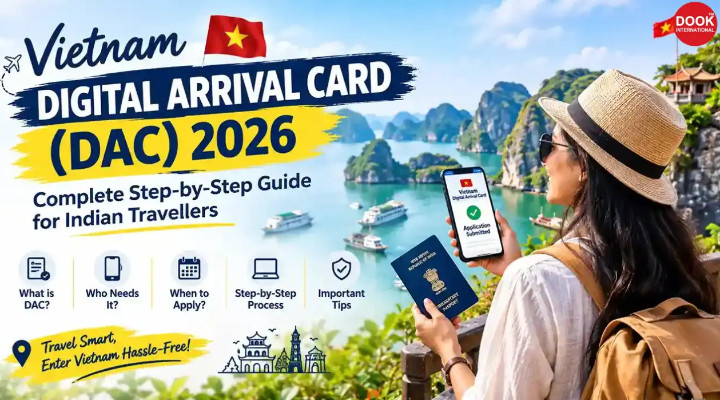
Vietnam's Digital Arrival Card (DAC) — officially the Pre-Arrival Information (PAI) system — is now mandatory at all four of Vietnam's major international airports: Ho Chi Minh City (Tan Son Nhat), Hanoi (Noi Bai), Da Nang, and Phu Quoc. It is completely separate from your Vietnam e-Visa, completely free, and takes under 5 minutes to complete at prearrival.immigration.gov.vn. It must be submitted within 72 hours before your scheduled arrival. Missing it adds time at immigration; presenting it cuts the queue. This guide covers exactly what it is, what it is not, how to fill it step by step, and the one
mistake Indian travellers keep making.
| Official name | Pre-Arrival Information (PAI) system — also called Vietnam Digital Arrival Card (DAC) |
| Official portal | prearrival.immigration.gov.vn — free, no third-party fee |
| Cost | 100% free. Any site charging for this is fraudulent. |
| Mandatory at | Ho Chi Minh City (Tan Son Nhat/SGN) | Hanoi (Noi Bai/HAN) | Da Nang (DAD) | Phu Quoc (PQC) |
| Launched | April 15 2026 at Ho Chi Minh City. Expanded to Hanoi, Da Nang, Phu Quoc in subsequent months. |
| Submission window | Within 72 hours (3 days) before your scheduled Vietnam arrival. No earlier. |
| What it replaces | The old paper arrival card filled on the plane or at the counter |
| Is it a visa? | NO. It does not grant entry permission. Indian travellers still need a separate Vietnam e-Visa. |
| Result | QR code emailed immediately — present at immigration counter on arrival |
| Applies to transit? | Transit passengers who do NOT clear immigration are exempt. Those who clear immigration need it. |
| Children | Parents or guardians complete the form on behalf of children |
If you are planning a trip to Vietnam from India in 2026, there is a new step in your pre-departure checklist that did not exist a year ago. Vietnam's Immigration Department introduced a mandatory Digital Arrival Card — officially called the Pre-Arrival Information (PAI) system — for international arrivals at Ho Chi Minh City's Tan Son Nhat Airport from April 15 2026. Since then, the same requirement has expanded to Hanoi's Noi Bai Airport, Da Nang International Airport, and Phu Quoc International Airport — covering the four airports that handle the overwhelming majority of direct and connecting flights from India.
The form is free, takes under five minutes to complete, is submitted online at prearrival.immigration.gov.vn, and generates a QR code you show at the immigration counter when you land. It will not grant you the right to enter Vietnam — that is what your e-Visa does — but it is now a required additional step that is checked separately at the counter.
The most common mistake Indian travellers are making in 2026 is assuming that having a valid Vietnam e-Visa covers everything. It does not. The DAC is a separate requirement, submitted through a separate portal, within a separate time window. This guide covers both — what each document is, exactly how to fill the DAC, and the complete sequence for Indian travellers in 2026.
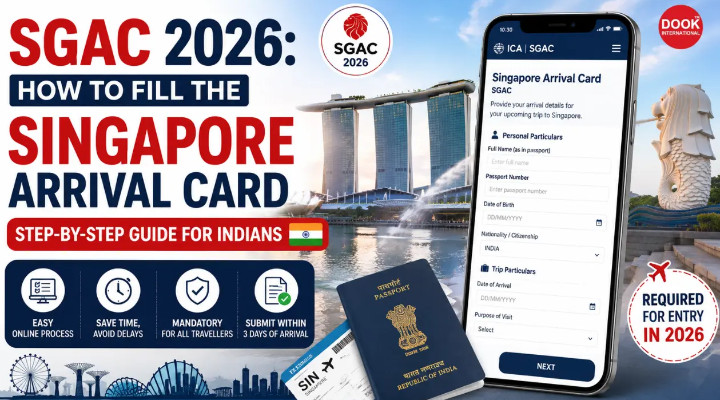
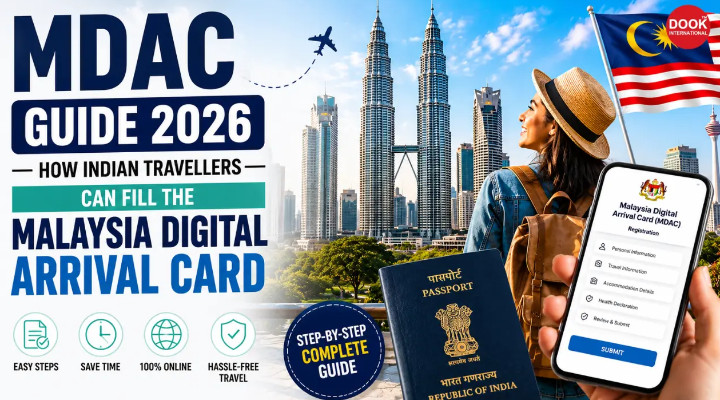
This article is the Vietnam equivalent of Dook's guides to the MDAC for Malaysia, TDAC for Thailand, SGAC for Singapore, and AIAC for Bali — the same procedural format, applied to Vietnam's new pre-arrival system.
What Is the Vietnam Digital Arrival Card (DAC) — And Why Did Vietnam Introduce It?
The Vietnam Digital Arrival Card is an online pre-arrival declaration form run by Vietnam's Immigration Department under the Ministry of Public Security. It collects your passport details, flight information, accommodation address, and entry document type before you arrive — then generates a QR code that immigration officers scan at the counter to retrieve your information electronically.
Vietnam introduced it specifically to address immigration congestion at Tan Son Nhat Airport (Ho Chi Minh City), which had become one of Southeast Asia's most congested immigration entry points, with some Indian travellers reporting queues of 500 people and waits of 90 minutes to two hours during evening peak arrivals. The DAC allows officers to retrieve passenger information electronically rather than entering it manually, cutting processing time per passenger.
The system is described as a phased rollout — Vietnam launched it at Ho Chi Minh City in April 2026 and has been extending it airport by airport since then, with the possibility of further expansion to additional entry points. The form also includes fields for land and sea entry modes, strongly suggesting the system is designed to eventually cover all of Vietnam's international entry points.
The Most Important Point: Vietnam DAC Is NOT Your Visa
This is the single most common confusion point for Indian travellers — and it must be understood before anything else.
| Vietnam e-Visa | Vietnam DAC (Digital Arrival Card) | |
| What it is | Your legal permission to enter Vietnam | Your pre-arrival immigration declaration |
| Grants entry? | YES — this is your authorisation to enter | NO — purely an entry declaration |
| Cost | USD 25 (approx Rs 2,100) for single entry 90-day e-Visa | FREE — zero cost |
| Portal | https://evisa.xuatnhapcanh.gov.vn/ | prearrival.immigration.gov.vn |
| Processing time | 3 working days | Instant — QR code generated immediately on submission |
| Submission window | Apply at least 1 week before travel | Within 72 hours (3 days) before your arrival only |
| Required for Indians? | YES — India is not visa-exempt for Vietnam | YES — from April 2026 at all four major airports |
| Can it replace the other? | No | No — both are required independently |
The Right Sequence for Indian Travellers to Vietnam
Step 1: Apply for Vietnam e-Visa at https://evisa.xuatnhapcanh.gov.vn/ (at least 1 week before travel, USD 25, 3 working days processing).
Step 2: Book flights and hotel.
Step 3: Within 72 hours before your Vietnam arrival, complete the DAC at prearrival.immigration.gov.vn (free, instant).
Step 4: Save the DAC QR code offline.
Step 5: At Vietnam immigration counter — present both your passport (with e-Visa) AND the DAC QR code. Both are checked independently.
Which Vietnam Airports Now Require the DAC — Current Status September 2026
The Vietnam DAC system has expanded significantly since its April 2026 launch. Here is the current status at each major airport as of September 2026:
| Airport | Code | DAC Status | Notes for Indian Travellers |
| Ho Chi Minh City — Tan Son Nhat | SGN | MANDATORY from April 15 2026 | First airport to require DAC. Most Indian flights to southern Vietnam land here. Submit before flying. |
| Hanoi — Noi Bai | HAN | MANDATORY — expanded post-April 2026 | Second largest airport. Handles direct flights from Delhi. Submit before flying. |
| Da Nang International | DAD | MANDATORY — expanded post-April 2026 | Gateway to Hoi An and Hue. Submit before flying. |
| Phu Quoc International | PQC | MANDATORY — expanded post-April 2026 | Island gateway. Submit before flying. |
| Other Vietnam airports | Various | Expansion ongoing — check before travel | Safest approach: complete the DAC regardless of entry airport as the cost of doing it unnecessarily is zero. |
Safest Approach for Indian Travellers
Since Vietnam is rolling out the DAC in stages and the exact rules at each gateway are still settling, complete the card before you fly regardless of your arrival airport, and check the current status for your entry point on the official portal a day or two before departure. Filling it out when it is not strictly required costs you nothing; arriving without it when it is required can mean slower passage through immigration.
How to Complete the Vietnam Digital Arrival Card: Step-by-Step
Official portal: prearrival.immigration.gov.vn — this is the ONLY legitimate Vietnamese government portal for the DAC. The form is free. Any website charging a fee for this is fraudulent.
| Step 1 | Open the Official Portal Within Your 72-Hour Window Go to prearrival.immigration.gov.vn within 3 days (72 hours) before your scheduled Vietnam arrival. The system will reject submissions made earlier than this window. If your flight arrives on September 15 at 10 PM, the earliest you can submit is September 12 just after 10 PM. Use your Vietnam arrival date and time, not your India departure time. |
| Step 2 | Select Your Arrival Airport and Mode of Entry The form asks for your port of entry. Select the correct airport from the dropdown — Ho Chi Minh City (Tan Son Nhat/SGN), Hanoi (Noi Bai/HAN), Da Nang, or Phu Quoc. The form also covers land and sea entry for future expansion, but most Indian travellers will select air arrival. Select your flight number and the date/time of your Vietnam arrival (not India departure). |
| Step 3 | Enter Passport and Personal Details Enter your full name exactly as it appears on your Indian passport — including middle name if present on the document. Enter your passport number, date of birth, nationality (Indian), and passport expiry date. The name and passport number must match your visa and your travel documents character-for-character. Any mismatch causes a flag at the immigration counter. |
| Step 4 | Enter Your Entry Document Type Select your entry document type from the dropdown: e-Visa, Visa on Arrival (approval letter), or Visa Exemption. Most Indian travellers select e-Visa. Enter your e-Visa reference number if prompted. The system links your declaration to your existing visa authorisation. |
| Step 5 | Enter Vietnam Accommodation Details Enter the full name and address of your first night's accommodation in Vietnam. This must match what is on your hotel booking confirmation. If staying with friends or family, enter their Vietnamese residential address. Do not leave this field incomplete — it is a mandatory field and immigration officers may ask to verify it against your hotel booking. |
| Step 6 | Submit and Save Your QR Code Review all fields carefully before submitting. After submission, a QR code is generated immediately and emailed to your registered address. This QR code is your proof of DAC completion. Screenshot it, save it to your camera roll, and email it to yourself for offline access. Print one copy as backup. You will need to present this QR code at the immigration counter when you arrive in Vietnam — the officer scans it to retrieve your declaration electronically. |
| Mistake | Why It Causes Problems and How to Avoid It |
| Assuming the e-Visa covers everything | The DAC is a completely separate requirement. Having a valid e-Visa does not exempt you from submitting the DAC. Both are checked independently at the immigration counter. |
| Submitting more than 72 hours early | The portal rejects submissions outside the 72-hour window. Wait until the window opens — set a phone reminder for exactly 72 hours before your scheduled arrival. |
| Using departure date instead of arrival date | If your flight departs Delhi at 11 PM on September 14 and lands Ho Chi Minh City at 6 AM on September 15, your Vietnam arrival date is September 15. Always use the arrival date in Vietnam, not your India departure date. |
| Not saving QR code offline | Airport Wi-Fi at Tan Son Nhat can be slow. Screenshot your QR code and save it to your phone's camera roll before boarding, not after landing. |
| Paying a third-party site | The DAC is free at prearrival.immigration.gov.vn. Multiple third-party sites charge Rs 500–2,000 for this free service. Use only the official government portal. |
| Skipping it for Hanoi or Da Nang | The DAC initially launched only at Ho Chi Minh City, so some travellers arriving via Hanoi or Da Nang assumed they were exempt. The system has since expanded to all four major airports. |
| Name mismatch with passport | Enter your name exactly as on your Indian passport, including any middle name. Even a minor spelling variation can cause a flag at the immigration counter. |
Vietnam e-Visa for Indians in 2026: The Separate Requirement You Also Need
Since the DAC is not a visa, Indian travellers must still apply for a Vietnam e-Visa separately before travel. Here is the current status:
| Vietnam e-Visa Details (2026) | For Indian Applicants |
| Official portal | https://evisa.xuatnhapcanh.gov.vn/ — official Vietnam Immigration Department portal |
| Cost | USD 25 (approx Rs 2,100) for a single or multiple entry 90-day e-Visa |
| Processing time | 3 working days. Apply at least 1 week before travel as a safety buffer. |
| Validity | 90 days from date of entry (not date of issue) |
| Entries | Single or multiple entry — select at application |
| Documents required | Valid Indian passport (6 months+ validity), digital passport photo, confirmed Vietnam hotel/accommodation address, return/onward ticket |
| Invitation letter required? | NO — the e-Visa system is fully online with no invitation letter needed |
| VFS appointment required? | NO — entirely online process, no in-person visit |
Akasa Air Mumbai–Hanoi Direct from September 4 2026
Akasa Air launched direct flights between Mumbai and Hanoi on September 4 2026, operating four flights per week. This new route makes northern Vietnam significantly more accessible for Indian travellers — cutting out the Bangkok, Kuala Lumpur, or Singapore connection that most Mumbai-Hanoi itineraries previously required. If you are flying this route, both your Vietnam e-Visa and the DAC for Hanoi's Noi Bai Airport are required before boarding.
How Vietnam's DAC Compares to Other SE Asia Arrival Cards Indian Travellers Know
Indian travellers familiar with the MDAC (Malaysia), TDAC (Thailand), SGAC (Singapore), or AIAC (Bali/Indonesia) will find Vietnam's DAC follows the same format. Here is how they compare:
| Vietnam DAC | Malaysia MDAC | Thailand TDAC | Singapore SGAC | Bali AIAC | |
| Cost | Free | Free | Free | Free | Free |
| Window | 72 hours | 72 hours | 72 hours | 3 days | 72 hours |
| Portal | prearrival .immigration .gov.vn | imigresen-online .imi.gov.my | tdac.thaiimmigration .go.th | eservices.ica .gov.sg | allindonesia .imigrasi.go.id |
| Replaces visa? | No | No | No | No | No — separate from VOA |
| Indians need visa? | Yes — e-Visa | No — visa free | No — 60-day visa free | Yes — e-Visa | Yes — VOA or e-VOA |
Pre-Flight Checklist: Vietnam Trip from India in 2026
• Vietnam e-Visa: Applied at https://evisa.xuatnhapcanh.gov.vn/, approved (USD 25, 3 working days), saved offline
• Vietnam DAC: Submitted at prearrival.immigration.gov.vn within 72 hours before arrival, QR code saved offline
• Indian passport: Valid 6 months+ beyond your Vietnam arrival date
• Hotel booking confirmation: Full address matching DAC entry — save offline
• Return/onward ticket: Immigration may ask — save offline
• Travel insurance: Covers Vietnam — see Dook's travel insurance for international trips guide for what a Southeast Asia policy should include
• Vietnamese Dong (VND) or USD cash: Most street vendors and smaller establishments in Vietnam are cash-only. See Dook's cash limits abroad guide for RBI rules on carrying foreign currency.
• Yandex/Grab app: Download Grab before landing — the most reliable taxi app in Vietnam, including Ho Chi Minh City and Hanoi

 Admin
Admin 















 Hassle-free booking and best price guaranteed
 24/7 support available
 Hand-picked tours & activities
 Free travel insurance
 sales@dooktravels.com
 +918368513675