









By Dook International | Updated August 2026 | 13 min read | Sources: European Commission (home-affairs.ec.europa.eu), France Diplomatie, Forbes Travel, AFAR Magazine, Wego Travel Blog — all verified August 2026
Article Summary
Europe's new Entry/Exit System (EES) replaced passport stamps with biometric fingerprint and facial scans at all 29 Schengen borders from April 10 2026. For Indian travellers this means a new registration process at every Schengen entry, real queues of up to 3 hours at major airports during peak travel, the end of the passport stamp as proof of stay, and a critical update on ETIAS — which has been officially delayed to 2027 and requires absolutely no action from Indian travellers right now.
EES 2026: Fast Facts for Indian Travellers
| What it is | EU's new digital border management system replacing manual passport stamps |
| Operated by | eu-LISA (EU Agency for large-scale IT systems in justice and home affairs) |
| Fully operational since | 10 April 2026 across all 29 Schengen countries |
| Applies to Indians? | YES — all non-EU/non-Schengen nationals on short stays, including Indian visa holders |
| What it collects | Facial image, fingerprints (4 fingers), passport data, entry/exit date and place |
| Data stored for | 3 years from date of collection |
| Replaces | Manual passport stamp — your passport will no longer be stamped at Schengen borders |
| Queue reality | Up to 3 hours at busy airports; some southern European hubs reporting 5 hours at peak |
| ETIAS (separate system) | DELAYED to 2027 — no applications needed, no action required from Indians right now |
| Ireland and Cyprus | Do NOT participate in EES — standard checks still apply at these two countries |
| Children under 12 | Must register and provide a photo but are exempt from fingerprinting |
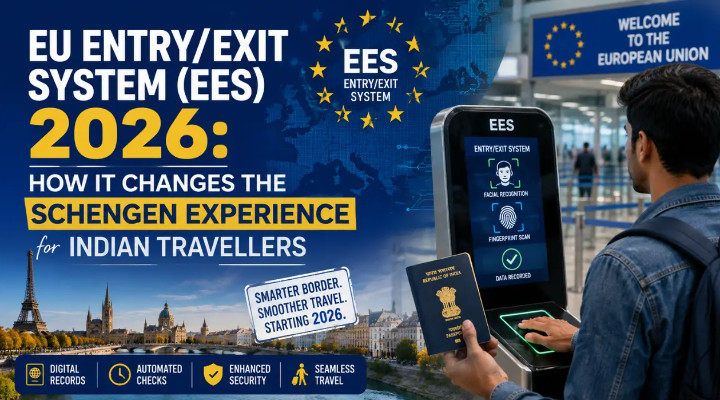
If you have travelled to Europe since April 2026, you already know the EES — you experienced it as a longer queue than expected at passport control, a new set of kiosks before the officer's window, and an officer who asked you to press your fingers on a scanner and look at a camera. If you are planning to travel to Europe and have not heard of it yet, this guide covers everything you need to know before you fly.
The European Union's Entry/Exit System (EES) is the most significant change to Schengen border crossing in decades. It has been in development since 2017, delayed multiple times, partially launched in October 2025, and became fully mandatory at all 29 Schengen borders on April 10 2026. What it does is replace the manual passport stamp — which border officers have been pressing into visitors' passports since the Schengen zone opened in 1985 — with a digital biometric record that links your face, fingerprints, and travel document to a centralised EU database.
For Indian travellers specifically — the second-fastest-growing outbound travel market in the world — the EES is not optional, not avoidable, and not a one-time registration. It applies every time you cross a Schengen external border. Here is exactly what happens, what changes for your trip, and what you need to do differently.
What Is the EU Entry/Exit System (EES) — And Why Did Europe Build It?
The EES is an automated IT system that registers non-EU nationals at every crossing of the Schengen external border. Before April 2026, the only record of a non-EU traveller's presence in the Schengen zone was a manual rubber stamp in their passport — a system the EU noted was easily forged, frequently missed, and impossible to verify digitally.
The EES solves three specific problems the old stamp system could not:
| Problem with Old System | How EES Fixes It |
| Overstayers undetectable — no way to know if someone left the Schengen zone or just stopped getting their passport stamped | Every entry AND exit is now recorded digitally. The system automatically flags anyone who has been inside Schengen beyond the 90/180-day rule. |
| Passport stamps easily forged or missed — manual errors routine | Biometric data (fingerprints + face) cannot be forged. Your identity is verified against the stored record at every border crossing. |
| No cross-border visibility — one country could not see what another had stamped | Every Schengen border post now sees the same centralised database. A refusal in Rome is visible at Amsterdam. |
Since launch, the EU Commission reported that over 45 million border crossings have been registered through EES. The system has already refused entry to over 24,000 people — including cases of identity fraud that the old stamp system would have missed, such as a traveller in Romania who was found to be using two separate identities with two different documents.
Exactly What Happens at the Schengen Border Now: Step by Step for Indian Travellers
The border crossing process has changed meaningfully. Here is the full sequence a first-time EES registrant goes through — and what repeat travellers experience from their second trip onwards.
First-Time EES Registration (Your First Schengen Entry After April 2026)
| Step 1 | Self-Service Kiosk (where available) At many major Schengen airports — Paris CDG, Amsterdam Schiphol, Frankfurt, Rome Fiumicino — self-service kiosks are available before the officer's window. Scan your passport, answer pre-registration questions, and position yourself for the facial scan. This pre-registration speeds up the officer's window step. Note: kiosks are not yet available at all ports of entry. |
| Step 2 | Border Officer Window Present your passport and Schengen visa. The officer will: (1) scan your passport into the EES terminal, (2) ask you to look at the camera for a facial photograph, (3) ask you to place four fingers of each hand on the fingerprint scanner — eight fingerprints total on your first registration. Children under 12 provide a facial photo only; fingerprinting is waived for this age group. |
| Step 3 | Declaration of Purpose and Accommodation The officer may ask about the purpose of your visit and your accommodation address — particularly if this is your first registration, as the system does not yet have a prior travel history for you. This is standard Schengen entry questioning, now captured digitally alongside your biometrics. |
| Step 4 | Entry Recorded Digitally Your entry is stored in the EES database — date, time, port of entry, and your biometric data. Your passport will NOT be stamped. This is the end of the passport stamp era for Schengen travel. If you have an older passport with many European stamps and plan to use that as a travel history reference, note that this is no longer how your European travel is tracked. |
Repeat Visitors — What Changes on Your Second Trip Onwards
Once your biometric data is stored in the EES database from your first registration, subsequent Schengen entries are significantly faster:
• Fingerprint or facial scan only: The system retrieves your existing record from one biometric check — you do not need to re-register all eight fingerprints.
• Automated gates (e-gates): At airports with operational e-gate infrastructure (CDG Paris, Schiphol, Frankfurt), returning EES registrants may be able to use automated gates for faster processing — similar to how EU residents use their national ID gates.
• Your 90/180 day count is updated automatically: Each entry and exit updates your digital travel record in real time. Border officers can see exactly how many days you have used and how many remain — across all 29 Schengen countries combined.
What 90/180 Days Means — And Why EES Makes It More Enforced Than Before
The Schengen 90/180 rule allows non-EU nationals (including Indians on short-stay visas) a maximum of 90 days within any 180-day rolling period across all 29 Schengen countries combined. Before EES, tracking this was partially manual — officers stamped passports, but overstays were difficult to detect systematically. Now, EES records every entry and exit digitally. The system automatically flags anyone who has exceeded 90 days. Overstay is now visible to every Schengen border post simultaneously. If you have ever used more than 90 days in any 180-day Schengen period, the EES database will show this from your first registration onwards.
The Queue Reality: How Long Are EES Border Waits Actually Taking in August 2026?
This is the aspect most travel articles underreport. The EES rollout has caused significant queue disruption at European airports, and the situation as of August 2026 — peak summer travel season — is materially worse than the EU's initial projections.
The official EU position: The European Commission maintains that EES was launched successfully and that disruptions are being managed. A Commission spokesperson said the phased approach was designed to prevent exactly the kind of mass disruption seen at some airports.
The industry position: On July 1 2026, ACI Europe (Airports Council International), Airlines for Europe, and IATA jointly wrote to European Commission President Ursula von der Leyen warning the rollout had reached a "critical point." Nine European member states have independently urged the EU to ease EES checks. The EU has refused to pause the system.
| Airport/Entry Point | Queue Reality (August 2026) | Practical Advice for Indian Travellers |
| Paris CDG (France) | 30–90 minutes at non-peak times; up to 3 hours during peak summer flights | Arrive at the airport minimum 3.5 hours before your next flight. Self-service kiosks available — use them before joining the officer queue. |
| Amsterdam Schiphol (Netherlands) | 30–60 minutes standard; 2+ hours peak | Schiphol has among the better e-gate infrastructure for returning EES registrants. First-time registrants face longer waits. |
| Frankfurt (Germany) | 30–60 minutes generally | Relatively well-staffed; infrastructure upgrades ongoing. |
| Rome Fiumicino (Italy) | 1–3 hours at peak; southern European hub listed among EU's '20 difficult spots' | Allow 4 hours buffer for connections. Rome is one of the worst-affected airports in the EU's own assessment. |
| Lisbon (Portugal) | Portugal suspended EES at Lisbon in December 2025 before resuming; 1–2+ hours in summer | Lisbon had one of the earliest recorded major disruptions — 24 National Guard officers deployed in January 2026. |
| Greek airports (Athens, Heraklion) | Variable — Athens relatively better managed; island airports more challenging | Greek tourism surged post-direct-flight-from-India; plan extra time at smaller island airports. |
| Land border crossings | Lower traffic, faster generally | Land borders (entering from non-Schengen neighbours) have shorter EES queues than major airports. |
Practical Rule for Indian Travellers in 2026
For your first Schengen entry: arrive at passport control with at least 90 minutes to spare, regardless of your next flight connection time.
If your trip involves a Schengen airport connection — for example, flying Mumbai to Paris, then Paris to Rome — you will go through EES at Paris as your Schengen entry point. Allow at least 3 hours connection time at any Schengen hub until queue times improve.
See Dook's Airport Layover Guide for the specific transit rules at Schengen hubs and how long layovers should be in 2026.
What Has Actually Changed for Indian Travellers: Old System vs EES
| Aspect | Before EES (pre-April 2026) | After EES (April 2026 onwards) |
| Border crossing process | Show passport, get stamped, walk through | Show passport, scan fingerprints, facial photo, digital entry recorded. No stamp. |
| Passport stamps | Every Schengen entry stamped | No more stamps. Passport pages preserved but EES is the official record. |
| Proof of Schengen stay | Passport stamps served as evidence | Digital EES record is the official record. Officers can retrieve it from any Schengen border. |
| 90/180-day tracking | Manual — counting passport stamps, easy to miss or dispute | Automated — system calculates your remaining days in real time and flags overstays automatically. |
| Data stored | Nothing beyond the stamp in passport | Name, passport data, facial image, fingerprints, entry/exit dates — retained for 3 years. |
| Queue time (first entry) | 5–20 minutes at most major airports | 30 minutes to 3+ hours depending on airport and time of day. |
| Queue time (repeat visits) | Same as above — no faster | Potentially faster via e-gates once biometrics are on file. |
| Data privacy | None collected | Biometric data stored under EU GDPR and eu-LISA data protection rules. Shared across 29 Schengen members. |
EES vs ETIAS: The Critical Distinction Indian Travellers Are Confusing
EES and ETIAS are two separate EU systems that are being confused with each other — partly because they were announced together and partly because travel articles have conflated them. They are entirely different, and the confusion is causing unnecessary anxiety among Indian travellers.
| EES (Entry/Exit System) | ETIAS (European Travel Information and Authorisation System) | |
| What it is | Digital border check at the Schengen border — biometric registration at entry and exit | Pre-travel online authorisation (like US ESTA or UK ETA) — applied for before you fly |
| Status | FULLY OPERATIONAL since April 10 2026 | DELAYED — not operational. Official 2026 launch is now widely reported as 2027. |
| Applies to Indians? | YES — all Indian passport holders with Schengen visas | NOT YET — Indians already need a Schengen visa and ETIAS would only apply to visa-exempt travellers anyway |
| Action needed? | Nothing to do in advance — EES registration happens automatically at the Schengen border | NO ACTION NEEDED. Do not apply on any website claiming to offer ETIAS — the system is not live and no genuine applications are being collected. |
| Cost | No separate fee | EUR 7 when launched — but not yet |
⚠️ Critical Warning: ETIAS Scam Websites
Because ETIAS has been widely publicised, dozens of third-party websites are collecting 'ETIAS applications' and charging EUR 70–100 for a service that does not exist yet. The official EU ETIAS system is not operational. No genuine ETIAS applications are being collected anywhere. The EU has confirmed it will give travellers several months' notice before launch. Any site currently asking for payment to apply for ETIAS is fraudulent. Do not pay.
Which 29 Countries Are Part of EES — And the Two That Are Not
EES applies across the 29-country Schengen Area. Two EU member states — Ireland and Cyprus — do not participate in EES and maintain standard border controls.
| EES Countries (29) — Schengen Area | Countries NOT in EES |
| Austria, Belgium, Croatia, Czech Republic, Denmark, Estonia, Finland, France, Germany, Greece, Hungary, Iceland, Italy, Latvia, Liechtenstein, Lithuania, Luxembourg, Malta, Netherlands, Norway, Poland, Portugal, Romania, Slovakia, Slovenia, Spain, Sweden, Switzerland | Ireland — maintains own border controls. No EES. Ireland visa still required separately for Indians. Cyprus — not yet in Schengen; maintains own border controls. |
For Indian travellers planning trips to Ireland alongside Europe — London + Dublin + Paris, for example — note that the UK, Ireland, and mainland Schengen are three separate immigration zones with three separate visa requirements. See Dook's Airport Layover Guide for Indians for the full breakdown of which transit hubs require which documents.
Your Data in the EES: What Is Stored, Who Sees It, and How Long It Is Kept
The EES collects biometric and personal data that is stored in a centralised EU database operated by eu-LISA. For Indian travellers who are accustomed to providing biometrics for visa applications, the EES data collection is similar — but the storage and access rules are specific.
• What is stored: Full name as on passport, date of birth, passport number and expiry, nationality, facial photograph, fingerprints of four fingers of each hand (8 total), date/time and place of each entry and exit, and any refusal of entry records.
• Stored for: 3 years from the date of collection. If you overstay the permitted period, data is retained for 5 years.
• Who can access it: Border authorities of all 29 Schengen member states. Europol for security investigations. Data is NOT shared with non-EU countries or international law enforcement as a matter of routine.
• Data protection: The EU General Data Protection Regulation (GDPR) and specific EES Regulation (EU) 2017/2226 govern data handling. eu-LISA is subject to European Data Protection Supervisor oversight.
• Can you request deletion: You can request a correction if data is factually inaccurate. Deletion before the 3 years requires a formal request through the national data protection authority of the Schengen member state where you registered.
• Refusing biometrics: Refusing to provide fingerprints or a facial scan results in denial of entry to the Schengen Area. There are no exceptions for Indian Schengen visa holders.
Pre-Travel Checklist for Indian Travellers Visiting Europe in 2026
• Allow extra time at the airport: Add a minimum of 90 minutes to your expected border control time at Schengen entry points, especially Paris, Rome, Lisbon, and smaller Mediterranean airports during summer.
• Extend Schengen connection time: If connecting through a Schengen airport en route to another Schengen destination, book connections with at least 3 hours between flights — not the airline's 'minimum connection time' which does not account for EES queues.
• Nothing to apply for in advance: EES registration happens automatically at the border. There is no pre-registration portal, no fee, and no advance action required.
• Do not apply for ETIAS: ETIAS is delayed to 2027, and no genuine applications are being accepted. Any site charging for ETIAS is fraudulent.
• Your passport will not be stamped: If your Schengen visa application process required past stamps as evidence of previous travel, note that from April 2026 you will receive digital entries instead. Keep records of your EES entry date separately.
• Track your 90/180-day count carefully: EES makes overstay detection automatic. If you have previously used informal methods of extending Schengen stays (which were technically violations), the EES will flag these immediately.
• Travel insurance with missed-connection cover: EES border queues creating missed flights are not the airline's responsibility and do not trigger standard delay compensation. Travel insurance with missed-departure cover is the realistic protection. See Dook's travel insurance for international trips guide for what European coverage should include.
• Carry your Schengen visa document: Your Schengen visa sticker or approval letter must still be presented alongside your passport at the EES border — EES records the crossing; your visa is still the authorisation to enter.
Planning Your Europe Trip from India?
Dook International builds Europe tour packages for Indian travellers that factor in current entry requirements, connection times, and documentation changes — including the new EES border reality. Our packages include complete pre-travel guidance, Schengen visa assistance, and itineraries built around realistic 2026 border crossing times.

 Admin
Admin 





















 Hassle-free booking and best price guaranteed
 24/7 support available
 Hand-picked tours & activities
 Free travel insurance
 sales@dooktravels.com
 +918368513675