







By the Dook International travel team | Updated 22 October 2026 | 8 min read
The short answer
Where to buy: carpet shops in the Old City (Icherisheher) and around the Carpet Museum on the Boulevard. Markets are cheaper but rarely give export papers.
What to check: look at the back, the fringe and the knots, and ask for a written receipt that states the size, material, age and that it is handmade.
The paperwork: the UK Foreign Office says you need an export certificate to take carpets out of Azerbaijan. Your seller can usually provide it, or you can get one from the Azerbaijan National Carpet Museum.
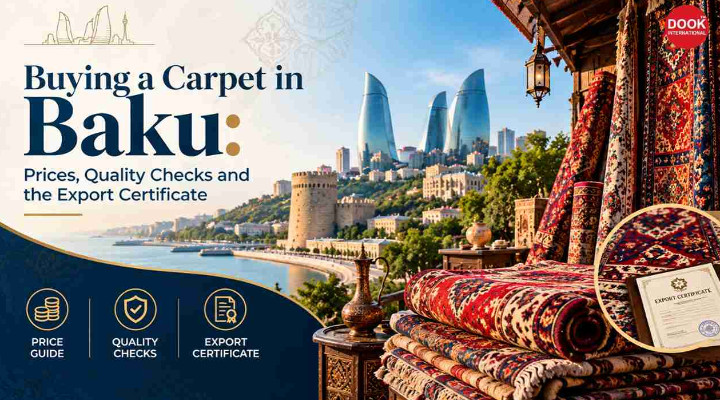
It is easy to walk past the carpet shops in Baku's Old City, but they are worth a stop. Azerbaijani carpets are bold, colourful and often more geometric than the floral Kashmiri carpets most of us know. A small rug can be a beautiful, lasting souvenir, and a large one can be a family heirloom.
It can also go wrong. Machine-made rugs are sold as handmade, viscose is sold as silk, and travellers are held at the airport without the right paperwork. This guide helps you buy with confidence.
Why Azerbaijani carpets are worth buying
UNESCO added the traditional art of Azerbaijani carpet weaving to its intangible heritage list in 2010. Weavers work with wool, silk, and sometimes gold and silver thread, and use natural dyes. The main regional schools are Guba-Shirvan, Ganja-Gazakh, Karabakh, and Tabriz, each with its own patterns and colours (UNESCO Azerbaijan).
| Type | What it means |
| Pile carpet (khalcha) | The classic knotted carpet with a soft pile. Value depends on knot density, material, and age. |
| Flat-woven (kilim, sumakh, zili, verni) | No pile. Lighter, easier to pack, usually cheaper, and great as wall hangings or throws. |
| Small pieces and bags | Cushion covers, saddle bags (khurjun), and framed mini rugs make easy, affordable gifts. |
Where to buy a carpet in Baku
• Old City (Icherisheher) shops: the widest choice of new and older handmade carpets, with dealers used to foreign buyers and export paperwork. Compare at least three shops.
• Around the Carpet Museum on the Boulevard: visit the Azerbaijan National Carpet Museum first. Seeing museum pieces up close trains your eye for good weaving.
• Markets: cheaper, but quality varies, and export documents are rarely offered. Ask before you pay.
Carpet shopping fits easily into an Old City afternoon. Our guide to things to do in Baku helps you plan the rest of the day.
What decides the price
Carpet prices in Baku vary a lot, from modest sums for small new rugs to very large amounts for fine silk or antique pieces. Instead of a single price list, use these factors to judge whether a quote makes sense.
| Factor | How it affects price |
| Handmade or machine-made | Handmade costs far more and holds value. Machine-made should be priced as decor. |
| Material | Wool is the most common and durable. Pure silk costs much more. Wool and silk mixes sit in between. |
| Knot density | More knots per square decimetre means finer detail and a higher price. Azerbaijani carpets range from about 1,600 to 4,900 knots per square decimetre. |
| Size | Price rises roughly with area, so ask for the price per square metre to compare shops. |
| Age | Newer carpets are easier to export. Older pieces can be costly and may be restricted. |
| Dyes and design | Natural dyes and complex regional designs add value. |
For a sense of scale: one shopper who compared six Old City stores reported first asking prices of about 230 to 300 manat for a small silk carpet under 1 square metre. That report is several years old, so treat it as a starting point only.
How to bargain
• Never accept the first price. Dealers expect to negotiate, often over tea.
• Aim for about 10 to 20% below the first asking price, more if you buy several pieces.
• Compare the same size and material across shops before you commit.
• Walk away politely if it doesn't feel right. Many buyers return later to the same shop at a better price.
7 quick checks for a genuine handmade carpet
1. Flip it over. On a handmade carpet, the pattern on the back is clear and matches the front, with small irregular knots. A very even, grid-like back suggests a machine.
2. Check the fringe. On handmade pieces, the fringe is the end of the warp threads running through the carpet. A fringe sewn or glued on afterwards is a warning sign.
3. Look for small imperfections. Slight variations in shape or colour are normal in handwork. A perfectly uniform carpet is more likely machine-made.
4. Count the knots. Ask the seller to show the knot count on the back. More knots mean finer work and a higher price.
5. Test the dye. Rub a slightly damp white tissue on the surface. Colour coming off can mean poor dyes.
6. Question the silk. Shiny "silk" at a low price may be viscose (art silk). Real silk is cool and smooth, and it costs far more than wool.
7. Get it in writing. Ask for a receipt that states the size, material, approximate age, origin and that the carpet is handmade.
The export certificate: what you need to know
According to UK government travel advice, you need an export certificate to take antiques or art, including carpets, out of Azerbaijan. Your vendor can give you one, or you can get it from the Azerbaijan National Carpet Museum (GOV.UK, Azerbaijan entry requirements).
• Get a certificate for any handmade carpet, even a new one. It is the simplest way to avoid questions at the airport.
• Be careful with old carpets. Pieces that count as national cultural heritage may not be exported at all. Sources differ on the age cut-off, citing 1950, the 1960s, or 30 years, so ask before you buy anything old.
• Ask the seller to arrange it. Reputable shops usually provide the certificate at purchase. If not, allow time to get it from the museum, as it may not be issued the same day.
Keep papers in your hand luggage: the certificate and the receipt, ready to show at customs.
Ask before you pay
"Is this carpet handmade, what is it made of, and how old is it?"
"Will you provide the export certificate, and is it included in the price?"
"Can you write the size, material, and age on the receipt?"
Bringing the carpet into India
Under India's Baggage Rules 2026, residents can bring in goods worth up to ₹75,000 duty-free, and a carpet counts towards that total along with your other shopping. If you go over the limit, declare it at the red channel and pay duty on the excess. Keep the receipt to show its value. Our guide to India's duty-free limits explains the rules.
Packing and carrying it home
• Ask the shop to roll and wrap the carpet tightly. Many shops pack carpets for travel.
• Wool carpets are heavier than they look. Check your airline's checked-baggage allowance before you buy.
• Flat-woven kilims fold small and are the easiest to carry.
If the shop offers shipping, get the tracking details and insurance terms in writing.
Plan your Baku trip
Our Baku itineraries include the Old City, where most carpet shops are,so you will have time to browse and compare shops. Browse our Baku tours and tell us your dates.
 Admin


























 Hassle-free booking and best price guaranteed
 24/7 support available
 Hand-picked tours & activities
 Free travel insurance
 sales@dooktravels.com
 +918368513675
