




By the Dook International travel team | Updated 16 November 2026 | 8 min read
The short answer
Where: Bokonbaevo, a village on the south shore of Lake Issyk-Kul, is the easiest place in Kyrgyzstan to see eagle hunters. Several families there fly golden eagles for visitors.
What it costs: booked locally, a 1–2 hour demonstration usually costs 2,000–5,000 som (about ₹2,150–₹5,400) per person.
When: demonstrations run all year. Real hunting happens in winter, and the Salbuurun festival in Bokonbaevo is usually held in early August.
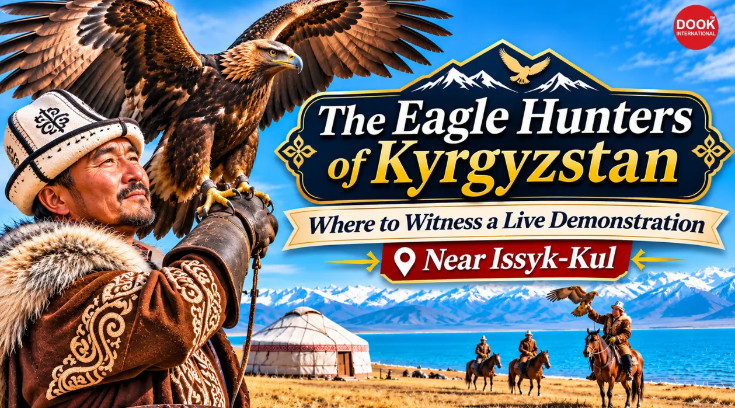
A golden eagle weighs about 5 to 7 kg and has a wingspan wider than a man is tall. Watching one launch from a hunter's glove, sweep low over the steppe, and drop onto a lure is one of the most memorable things you can do in Central Asia.
In Kyrgyzstan, the hunters are called berkutchi, from berkut, the Kyrgyz word for golden eagle. This guide covers what the tradition is, where to see it near Issyk-Kul, what a demonstration includes, prices, and how to choose one that treats the birds well.
Eagle hunting in Kyrgyzstan at a glance
• Best place: Bokonbaevo and nearby villages on Issyk-Kul's south shore, in the Ton district
• Distance: about 260–300 km from Bishkek, or 5 to 6 hours by minibus
• Show length: about 1 to 2 hours
• Hunting season: roughly late October to February
• Heritage status: Kyrgyzstan is one of 24 countries listed under UNESCO's “Falconry, a living human heritage”
• Booking: a day or two ahead through your guesthouse, community tourism office (CBT Bokonbaevo) or a local tour company
What is eagle hunting?
Nomads in Central Asia have hunted with birds of prey for centuries. In the long Kyrgyz winters, eagles caught foxes and hares, which gave families fur for warm clothing and some extra food. Training and feeding an eagle took years, so a good bird was a mark of status.
Kyrgyzstan joined the multinational UNESCO listing for falconry in 2021, alongside Kazakhstan, Mongolia and 21 other countries. See UNESCO's listing of falconry as a living human heritage.
How the eagles are trained
• Hunters usually take a young eagle from the wild and train it slowly, first to return to the glove for a meat reward, then to chase a fur lure dragged on a rope.
• Training takes years, and the hunter flies the bird almost every day to keep it fit and keen. A leather hood keeps the eagle calm between flights.
• On a hunt, the eagle often works with taigans, a Kyrgyz breed of sighthound. The dogs flush prey from the bushes while the eagle circles above.
• Most hunters release their eagles back into the wild to breed after many years. Figures of 8 to 20 years are quoted. One Issyk-Kul trainer told the Kabar news agency that owners usually keep their eagles for 15 to 20 years before letting them go.
Where to see eagle hunting near Issyk-Kul
Bokonbaevo: the main base
Bokonbaevo is a small village on Issyk-Kul's quieter south shore, and the hub for eagle hunting in Kyrgyzstan. Several berkutchi families live in and around it, and many guesthouses and yurt camps can call a hunter for you. Demonstrations usually take place on open ground near the lake or in the hills just outside the village.
Festivals with eagle hunters
• Salbuurun festival, Bokonbaevo: usually held in early August. It brings together eagle hunters, archers on horseback and taigan dogs, with music, crafts and food. The 2025 edition was held on 2 August.
• Winter events: Salbuurun competitions are also held in winter. In February 2026, finals took place at the hippodrome in Bokonbaevo, alongside horse races.
• Birds of Prey festival: the community tourism office in Bokonbaevo has organised this event in past years, in August, at a yurt camp in the hills near Kok-Sai.
Festival dates change each year and are often announced only a few weeks ahead, so check with your guesthouse or tour company before you plan around one.
What happens at a demonstration
A typical show lasts 1 to 2 hours and follows a similar pattern:
• The hunter, usually in a traditional coat and felt ak-kalpak hat, introduces the eagle and explains how it was trained, fed, and cared for.
• The eagle flies to the hunter's glove from a hillside or a distance, often to a whistle.
• It then chases a fox or jackal skin dragged behind a person or a galloping horse, and pins it to the ground.
• Taigan dogs may run after the same lure.
• Many shows end with a short lesson in traditional archery, and a chance to hold the eagle on a heavy leather glove for photos.
How much does an eagle hunting show cost?
• Booked locally: about 2,000–5,000 som (₹2,150–₹5,400) per person, depending on group size and whether transport is included. Larger groups pay less each.
• Booked online on global platforms: about $99 (around ₹9,500) per person for a 1-hour eagle show and archery lesson.
• Full-day winter hunt: joining a hunter in the mountains with horses, a guide, and lunch has been offered for about $220 (around ₹21,000) per person. These trips are rare and run only in season.
• Guesthouse stay in Bokonbaevo: about 1,000–2,000 som (₹1,100–₹2,150) per person per night, usually with meals.
Carry small som notes. Hunters and small guesthouses are usually paid in cash.
How to choose an ethical demonstration
Choose hunters who fly the eagle freely and keep it hooded and calm between flights. Walk away from places where birds are kept chained up for tourist photos.
Ask in advance whether the show uses a fur lure. Some demonstrations release a live rabbit or other animal, so say if you prefer a lure-only show.
Do not touch the eagle unless the hunter invites you, and avoid flash photography and drones near the birds.
Book through a guesthouse, the community tourism office, or a registered local company, so the money reaches the hunting families.
How to get to Bokonbaevo
• From Bishkek: minibuses leave Bishkek's Western bus station and take about 5 to 6 hours. A private car is faster and lets you stop at Konorchek Canyon on the way. If you have time in the capital first, see our list of things to do in Bishkek.
• From Karakol: follow the south-shore road west. Minibuses and shared taxis run between the two towns.
• Getting to the show: most hunters will meet you at your guesthouse or yurt camp, or the host can arrange a short transfer.
What else to do on the south shore
• Skazka (Fairy Tale) Canyon: red sandstone formations a short drive from the lake.
• Kyzyl-Tuu: a village where families still build traditional yurts by hand.
• Shyrdak workshops: see how Kyrgyz felt carpets are made, another UNESCO-listed craft.
• Issyk-Kul beaches and yurt camps: the south shore is quieter and less built-up than the north.
For more on the lake and its other sights, read our Issyk-Kul Lake guide.
Best time to see eagle hunting in Kyrgyzstan
• May to September: warm weather, easy travel and the Salbuurun festival in early August. This is the most comfortable time for a demonstration.
October to February: the real hunting season, when berkutchi take their eagles into the mountains after foxes. It is cold, but it is the most authentic time to go.
Tips for Indian travellers
Visa: Indians can apply online for a Kyrgyz e-visa through the official portal, evisa.e-gov.kg. Allow at least 3 working days.
Vegetarian food: Kyrgyz meals are meat-heavy, but guesthouses can usually make vegetable soups, bread, eggs, salads, and dairy dishes if you ask a day ahead.
Dress warmly: even in summer, the hills above the lake are windy. In winter, temperatures fall well below freezing.
Language: few hunters speak English, so ask your host or guide to translate.
Add eagle hunting to your Kyrgyzstan trip
An eagle hunting demonstration fits easily into an Issyk-Kul trip, with a night in a south-shore yurt camp or guesthouse. Browse our Kyrgyzstan tour packages and ask us about adding Bokonbaevo to your itinerary.
 Admin























 Hassle-free booking and best price guaranteed
 24/7 support available
 Hand-picked tours & activities
 Free travel insurance
 sales@dooktravels.com
 +918368513675
