


Article Summary
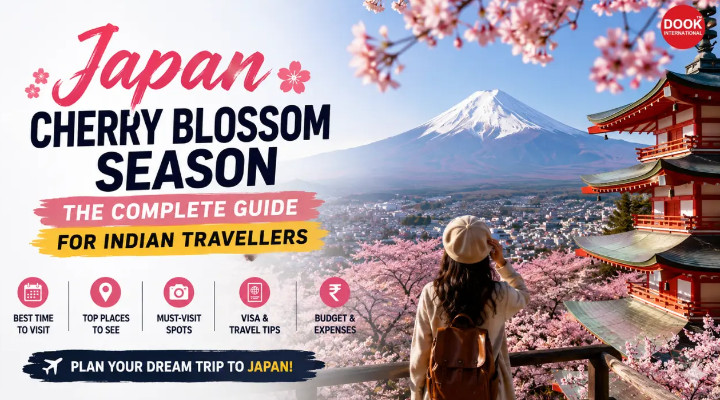
Japan's sakura season transforms the country into something that feels genuinely once-in-a-lifetime — and Indian arrivals during cherry blossom season jumped 38% in 2024. This is the complete India-focused guide: 2027 bloom forecast dates, the best spots in Tokyo, Kyoto, Osaka, and Hirosaki, realistic costs in INR, and everything you need to plan and book the trip.
| Quick Facts: Japan Cherry Blossom for Indians |
| Season window | Late March to early May (varies by city and year) |
| Tokyo peak bloom | Typically late March to early April (approx. March 25 – April 5) |
| Kyoto peak bloom | Typically early April (approx. April 1–10) |
| Hirosaki peak bloom | Late April to early May — less crowded, most dramatic |
| Indian arrivals growth | 38% jump in March-April 2024 vs 2019 (JNTO data) |
| Japan visa for Indians | eVisa (single entry, Rs 1,300) or sticker visa via VFS — 5-7 working days processing |
| Trip cost from India | Rs 1.5 lakh (budget) to Rs 3 lakh (mid-range) per person for 7-10 days |
| JR Pass (7-day) | Approx. Rs 28,000 — covers all Shinkansen (bullet train) travel |
| Best booking window | Apply for visa 6-8 weeks before travel; book flights and hotels 4-6 months ahead |
| Currency | Japanese Yen (JPY). 1 JPY = approx. Rs 0.57 (July 2026) |
There is a moment that happens to every traveller who arrives in Japan during cherry blossom season — usually on the morning of day two, standing in a park before the crowds arrive. The light comes through the canopy at an angle that makes the blossoms appear lit from within. The air carries a faint sweetness that has no Western equivalent. And the only reasonable response is to stop moving and just look.
For years, Indian travellers treated Japan as a distant aspiration: expensive to reach, complex to navigate, and culturally removed from anything familiar. That has changed decisively in the last two years. The Japan National Tourism Organization (JNTO) recorded a 38% jump in Indian arrivals during March–April 2024 versus 2019, with sakura tourism cited as the primary reason. The 2024 eVisa introduction simplified the process further. And in 2026, Japan is firmly on the radar of Indian travellers who want more than another beach destination.
This guide explains exactly what drives that shift — and gives you everything you need to plan the trip: what cherry blossom season is, when to go, where to go, what it costs in INR, how to get a visa, and why the window you think is the right one might not be.
What Is Hanami — And Why It Matters More Than You Think
Calling hanami 'flower viewing' is accurate but inadequate. The practice dates back over a thousand years to the Nara period, when Japan's imperial court held spring gatherings beneath blooming trees. By the Edo period, it had spread to every class of society and become Japan's most democratic cultural tradition: emperors and fishermen, under the same trees, doing the same thing.
Today, hanami is Japan's largest annual gathering. Parks that seat a few hundred people on ordinary days host thousands of families, office colleagues, and student groups for all-day picnics under the canopy. Convenience stores stock sakura-flavoured everything. Beer companies sponsor the illuminated night-viewing events. National weather forecasts include a sakura forecast alongside temperature and rain.
The philosophical core of hanami is mono no aware — the bittersweet awareness that beautiful things are temporary. Cherry blossoms bloom fully for 7–10 days at any single location, with the true peak (mankai, when 70% of blossoms are open) lasting just 4–5 days. The shortness is not a limitation; it is the entire point. Indians who travel for hanami almost universally describe it as one of the few experiences in international travel that genuinely exceeded expectations.
🌸 Key Sakura Vocabulary for Indian Travellers Sakura (桜) — Cherry blossom; the flower and the cultural event Hanami (花見) — 'Flower viewing'; the act of picnicking under cherry trees Kaika (開花) — First bloom; when the first few flowers open on the official observation tree Mankai (満開) — Full bloom; when 70%+ of blossoms are open. This is peak. Sakura zensen (桜前線) — Cherry blossom front; the northward wave of blooming across Japan Hanaikada (花筏) — 'Flower raft'; the layer of fallen petals on water, most famously at Hirosaki Yozakura (夜桜) — Night cherry blossom viewing; illuminated evening hanami |
Why Indian Travellers Are Discovering Japan's Cherry Blossom Season Now
The 38% surge in Indian arrivals during sakura 2024 was not accidental. It was the result of four simultaneous changes:
• The 2024 eVisa simplified the visa process significantly. Since April 2024, Indian tourists can apply for a single-entry Japan tourist eVisa digitally — receiving approval as a digital Visa Issuance Notice rather than a passport sticker. Processing runs 5–7 working days and the fee is just Rs 1,300 for a single-entry visa. The psychological barrier of 'Japan requires a complicated visa' no longer holds.
• JNTO's India marketing campaign has been deliberate. The Japan National Tourism Organization has specifically targeted Indian travellers through Bollywood-adjacent campaigns and partnerships with Indian travel platforms — correctly identifying that Indian travellers over-index on experiential travel and photography-driven destinations.
• Social media has made sakura visually unavoidable. Cherry blossom content from Japan consistently outperforms any other travel imagery on Instagram and Pinterest among Indian audiences. The combination of the Philosopher's Path canal, Mount Fuji's pink-framed silhouette, and Tokyo's illuminated night hanami parks hits every visual preference at once.
• More direct flight options and improved connectivity. IndiGo, Air India, and codeshare partners now offer routes from Delhi, Mumbai, Bengaluru, Chennai, and Kolkata to Tokyo with single connections. Total journey time from Delhi to Tokyo averages 9–11 hours with a Bangkok or Singapore connection.
Japan Cherry Blossom Season Dates: When to Visit for Indian Travellers
The Japan Meteorological Corporation (JMC) releases the official sakura forecast each January, updating it regularly as temperatures are tracked. The bloom window varies by 1–2 weeks between years based on winter temperatures. Here are the 2027 planning windows based on 2026 actuals and historical patterns:
| City / Region | First Bloom | Peak Bloom (Mankai) | Crowd Level |
| Fukuoka (Kyushu) | Mid to late March | Late March – early April | Medium |
| Tokyo (Kanto) | Late March (around March 20) | Late March – April 5 | Very High |
| Kyoto / Osaka (Kansai) | Late March – early April | April 1–10 | Very High |
| Hiroshima | Late March | Late March – early April | Medium |
| Yoshino, Nara | Early–mid April | Mid April (elevation-dependent) | High |
| Sendai (Tohoku) | Early April | Mid April | Low–Medium |
| Hirosaki, Aomori | Late April | Late April – early May | Low (most dramatic) |
| Sapporo, Hokkaido | Late April – early May | Late April – early May | Low |
📅 Best Dates for Indian Travellers: Practical Recommendation Fly out from Delhi or Mumbai between March 24–28. This window gives you the best statistical chance of catching peak bloom in Tokyo first (where flights from India typically arrive), then following the sakura front south-west to Kyoto and Osaka as those cities reach mankai. A 10-day trip is the practical minimum — enough to cover Tokyo (3–4 days), Kyoto (3 days), and Osaka or Hiroshima (1–2 days) while maintaining flexibility to linger where the bloom is peaking. Do not plan a 4-day trip timed to hit exact peak bloom — even 2–3 days of forecast variation wipes out a short trip. |
🌸 Secret for Late Travellers: Hirosaki Castle, Aomori If your school or work schedule means you can only travel in late April to early May, do not consider this second-best. Hirosaki Castle in Aomori, northern Honshu, contains 2,600 cherry trees across 50+ varieties and blooms in late April when Tokyo and Kyoto are finished. At peak, fallen petals fill the castle moat to create the hanaikada — a solid pink surface of floating blossoms that is Japan's most photographed late-season sakura image. Snow remains visible on the Iwaki mountains behind the castle. The crowds are a fraction of Tokyo or Kyoto. This is widely considered the finest castle cherry blossom combination in Japan by the Japan Cherry Blossom Association. |
Best Cherry Blossom Spots in Japan for Indian Travellers
Tokyo
🗼 Shinjuku Gyoen National Garden — Tokyo's Best Spot for Indian Travellers 1,100 trees across 65 varieties spread over 144 acres. Because the garden contains multiple cherry varieties with staggered blooming times, the park maintains a 2–3 week bloom window — the longest of any major Tokyo park. No alcohol permitted (unlike most hanami parks), which makes the atmosphere calmer and the photography cleaner. Entry: ¥500 (Rs 285). Open 9 AM – 4:30 PM. Pro tip: Go on a weekday morning. Weekend afternoons have queues at the entrance that can run 45+ minutes. |
🏯 Chidorigafuchi — Tokyo's Most Photographed Sakura Spot A 700-metre moat lined with overhanging cherry trees that frame the Imperial Palace grounds. Rowboats are available on the moat for a canal-level view of the blossoms from below — one of the most distinctive sakura photographs possible. Entry to the promenade: free. Rowboat rental: ¥800 for 30 minutes. Pro tip: Go 7–8 AM to avoid the rowboat queue, which reaches 2-hour waits at peak bloom weekend afternoons. |
🌿 Ueno Park — Tokyo's Liveliest Hanami Experience 800 trees, free entry, food stalls, lantern-lit evening events, and the full hanami atmosphere with Tokyo families and office groups. The experience is louder and more social than Shinjuku Gyoen — more like attending a festival than a garden visit. Entry: free. Pro tip: This is where you experience hanami as a cultural event, not just a photo opportunity. Go in the late afternoon when the lanterns come on. |
Kyoto
🛤️ Philosopher's Path (Tetsugaku no Michi) A 2-km canal path lined with approximately 500 cherry trees — the most postcard-perfect sakura walk in Japan. Connects Nanzenji temple to Ginkakuji (Silver Pavilion), with a dozen small cafes and craft shops along the route. Peak bloom makes this a continuous tunnel of pink. Entry: free. Pro tip: Walk south to north (Nanzenji to Ginkakuji) in the early morning before 8 AM. The light is better heading north, and the crowds build from the south end first. |
🏯 Maruyama Park — Kyoto's Night Cherry Blossom Icon Home to Kyoto's most famous single tree — the shidarezakura, a 300-year-old weeping cherry illuminated nightly during bloom season. The park fills with Kyoto families for evening hanami under paper lanterns. Entry: free. Pro tip: The illumination runs 18:00–22:00 during peak bloom. The weeping cherry surrounded by lit lanterns against a dark sky is the defining Kyoto sakura image. |
Osaka
🏯 Osaka Castle Park 3,000 cherry trees surround the historic Osaka Castle, combining Japan's most iconic feudal architecture with one of its largest single-site sakura collections. The elevated castle against a pink canopy is the strongest 'Japan' image for Indian travellers who want a single photograph that captures both culture and season. Entry to park: free. Castle interior: ¥600 (Rs 340). Pro tip: The castle moat side on the western approach is the best photography angle in the morning, when the castle catches the light directly. |
Hirosaki (For Travellers Who Can Go Late April – May)
🏔️ Hirosaki Castle Park, Aomori 2,600 trees across 50+ varieties make Hirosaki the most spectacular single-location cherry blossom in Japan. The hanaikada — fallen petals covering the moat surface in a solid pink layer — is Hirosaki's defining image. Residual snow on the Iwaki mountains provides a backdrop unavailable anywhere else in Japan. Entry to park: ¥320 during cherry blossom season. Pro tip: Hirosaki is 4 hours from Tokyo by Shinkansen and limited express. Budget an overnight stay rather than a day trip — the 6 AM light on the moat, before crowds arrive, is what most Hirosaki photographs are actually made at. |
Japan Cherry Blossom Trip Budget for Indians (INR Breakdown)
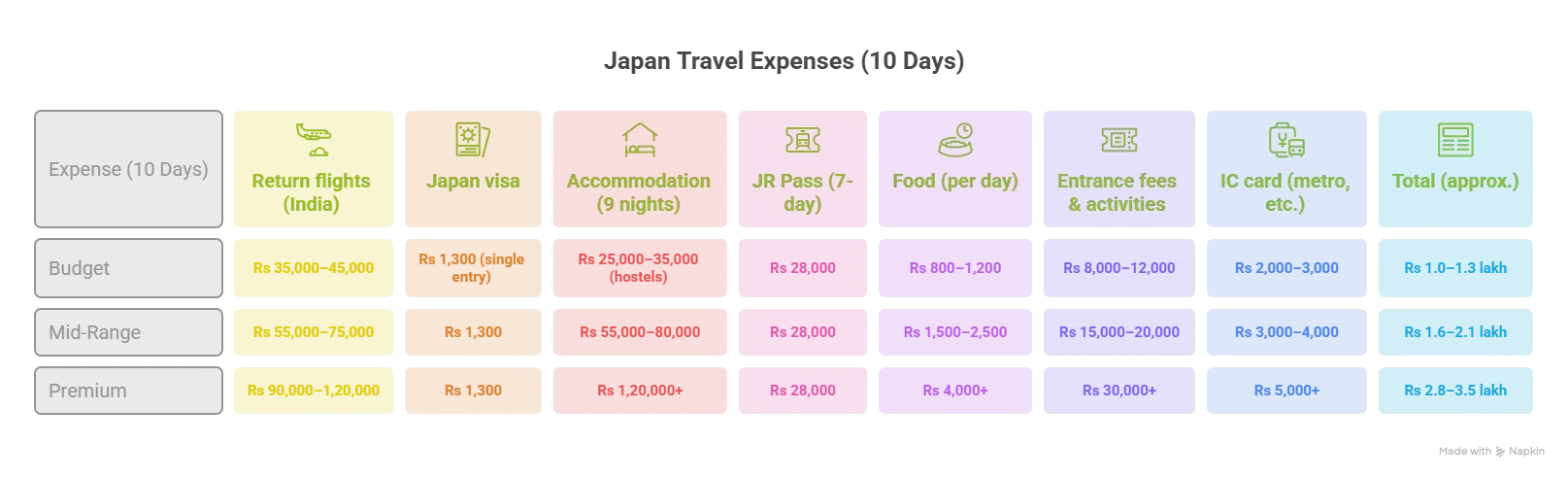
Japan has a reputation for being expensive. It is not cheap — but it is far more accessible than most Indian travellers expect, particularly when using public transport instead of taxis and eating at convenience stores and ramen counters rather than tourist restaurants.
| Expense (10 Days) | Budget | Mid-Range | Premium |
| Return flights (India) | Rs 35,000–45,000 | Rs 55,000–75,000 | Rs 90,000–1,20,000 |
| Japan visa | Rs 1,300 (single entry) | Rs 1,300 | Rs 1,300 |
| Accommodation (9 nights) | Rs 25,000–35,000 (hostels) | Rs 55,000–80,000 | Rs 1,20,000+ |
| JR Pass (7-day) | Rs 28,000 | Rs 28,000 | Rs 28,000 |
| Food (per day) | Rs 800–1,200 | Rs 1,500–2,500 | Rs 4,000+ |
| Entrance fees & activities | Rs 8,000–12,000 | Rs 15,000–20,000 | Rs 30,000+ |
| IC card (metro, etc.) | Rs 2,000–3,000 | Rs 3,000–4,000 | Rs 5,000+ |
| Total (approx.) | Rs 1.0–1.3 lakh | Rs 1.6–2.1 lakh | Rs 2.8–3.5 lakh |
💡 Three Budget Tips Specific to Sakura Season
1. Book accommodation 4–6 months before your visit. Hotel prices in Kyoto and Tokyo double or triple during peak sakura weeks. Cherry blossom dates are not fixed each year, so book with free cancellation where possible.
2. Buy a 7-day JR Pass before you leave India (approx. Rs 28,000 from the official JR Pass website). Activate it on Day 4 or 5 of your trip so it covers your inter-city Shinkansen days (Tokyo to Kyoto, Kyoto to Hiroshima, etc.). Do not activate on arrival — metro travel in Tokyo before heading to Kyoto uses a Suica IC card, not the JR Pass.
3. Food budget can be cut by 60% by eating from 7-Eleven, FamilyMart, and Lawson convenience stores — Japan's konbini are genuinely excellent, with hot dishes, fresh rice balls (onigiri), and curry options for Rs 150–300 per meal. This is not a compromise; it is how most Japanese people eat during the workday.
Japan Visa for Indians: What You Need Before Booking Sakura Flights
Japan does not offer visa-on-arrival to Indian citizens. You must have a valid visa before travel. The process is significantly simpler than it used to be, with two options:
| eVisa (Recommended) | Sticker Visa via VFS | |
| Cost | Rs 1,300 (single entry) | Rs 1,300 + VFS service fee Rs 1,500–2,200 |
| Apply through | MOFA-accredited Japanese travel agency or official MOFA portal | VFS Global Japan — 12 centres across India |
| Processing time | 5–7 working days | 5–7 working days (10–15 during peak season March–May) |
| Result | Digital Visa Issuance Notice (QR code shown at airport check-in) | Physical sticker in passport |
| Passport visit needed? | No — fully digital for eligible applicants | Yes — passport submitted to VFS |
| Stay permitted | Up to 90 days | Up to 90 days |
| Multiple entry? | No — single entry only via eVisa route | Available (3-year or 5-year for eligible travellers) |
| Best for | First-time Japan visitors, clean documentation | Repeat visitors, multiple-entry applicants |
⚠️ Critical Timing Note for Sakura Visa Applications During sakura season (March–May), VFS Global Japan processing at high-volume centres like Mumbai can extend to 10–15 working days due to application volume. Apply at least 6–8 weeks before your intended travel date. Do not plan to apply 2 weeks before a late March departure — this is when the queue is longest and processing is slowest. |
Practical Guide: Getting Around, Eating, and Etiquette for Indian Travellers
Getting Around
• JR Pass (7-day, Rs 28,000 approx.): Covers all Shinkansen (bullet train) between Tokyo, Kyoto, Osaka, and Hiroshima on the Tokaido-Sanyo line. Buy before leaving India — it cannot be purchased in Japan at the same price. Activate at any major JR station upon arrival.
• Suica or Pasmo IC card: A rechargeable card for Tokyo Metro, city buses, and convenience store purchases. Load it with Yen using any station machine. Buy on arrival at Haneda or Narita airport.
• Google Maps: Works perfectly for Japan public transport navigation. Shows train lines, times, platform numbers, and fare estimates in real time. Download offline maps for Tokyo and Kyoto before arriving.
Food for Indian Travellers
• Vegetarian: Japan is challenging for strict vegetarians. Dashi (fish stock) appears in most traditional Japanese dishes including ramen, udon, and miso soup. Explicitly vegetarian options are available at Indian restaurants (Bengaluru and Tokyo both have small clusters of Indian restaurants), Buddhist shojin ryori restaurants, and most convenience store sushi items. Inform restaurants: 'Watashi wa bejitarian desu' (I am vegetarian).
• Jain travellers: Very limited. Onion and garlic are in most Japanese cooking. Stick to fruit, packaged foods, and the rare Indian restaurant.
• Non-vegetarians: Japan is exceptional. Ramen, sushi, tonkatsu, tempura, yakitori — most restaurants operate one-specialty menus and produce extraordinary results. Chicken teriyaki, egg rice bowls (oyakodon), and salmon sushi are all safe and inexpensive.
Cultural Etiquette at Hanami
• Do not remove flowers or branches from trees — it is illegal and considered deeply disrespectful
• Hanami parks fill with groups who arrive early and mark their spot with a tarpaulin. This is accepted practice — arriving at 7–8 AM to claim a spot is normal, not rude
• Keep your area clean — Japanese hanami culture involves meticulous cleanup. Rubbish bags are carried in, filled during the picnic, and carried out. There are almost no public bins in Japanese parks
• Moderate alcohol consumption is normal and expected at hanami — in parks that allow it. Shinjuku Gyoen does not permit alcohol; most other parks do
• Be patient with queues. Long queues for specific viewpoints, boats, or entrances are normal. Pushing, skipping, or loudly expressing frustration is not acceptable
Pre-Departure Checklist: Japan Cherry Blossom Trip from India
• Book 4–6 months ahead: Flights and accommodation during sakura season fill fast. Book refundable accommodation where possible as bloom dates shift year to year
• Apply for Japan visa 6–8 weeks before departure: Allow for peak-season processing delays at VFS. eVisa route: 5–7 working days under normal conditions
• Buy JR Pass before leaving India: Must be purchased outside Japan. 7-day pass covers the full Tokyo-Kyoto-Osaka-Hiroshima route
• Download Google Maps offline for Tokyo and Kyoto: Works perfectly for train and metro navigation
• Get travel insurance: Japan's medical costs are among the highest in Asia — a single hospitalisation can cost USD 2,000–5,000+ without coverage. See Dook's guide on travel insurance for international trips for what a Japan-specific policy should include
• Monitor the JMC sakura forecast from January: The official Japan Meteorological Corporation forecast (n-kishou.com) updates regularly from January. Your bloom window may shift 1–2 weeks from historical averages
• Download IC card app or plan to buy Suica at airport: Required for Tokyo Metro and city buses. Load Yen from any station machine on arrival
• Pack for 5–10°C evenings: Late March in Tokyo and Kyoto is cold after sunset. Mornings at famous spots often require being there before 8 AM — bring a warm layer
Ready to Plan Your Japan Cherry Blossom Trip from India?
Dook International offers fully customised Japan tour packages from India for sakura season — flights, hotels near key viewing spots, the JR Pass, guided hanami experiences, and complete pre-travel documentation support including visa guidance. Our Japan packages are designed around actual bloom windows, with built-in flexibility for when the forecast shifts.

 Admin
Admin 





















 Hassle-free booking and best price guaranteed
 24/7 support available
 Hand-picked tours & activities
 Free travel insurance
 sales@dooktravels.com
 +918368513675