









By Dook International | Updated July 2026 | 14 min read | Sources: IRDAI, Insurance Samadhan, Bima Bharosa, Bajaj General Insurance, Tata AIG
Article Summary |
| The Claim Reality in India 2026 | |
| 35-40% of all travel insurance claim rejections in 2026 are due to insufficient or missing documentation alone | Source: PSU Connect / Insurance industry data 2026 |
| 69% of grievances filed on Bima Bharosa in FY 2024-25 were claim-related | Source: IRDAI / Bima Bharosa annual data |
| 57% of Insurance Ombudsman cases in FY 2023-24 were decided in favour of policyholders | Source: IRDAI Ombudsman statistics |
| Insurance Ombudsman handles claims free of charge up to Rs. 50 lakh | Source: IRDAI Insurance Ombudsman Rules 2017 |
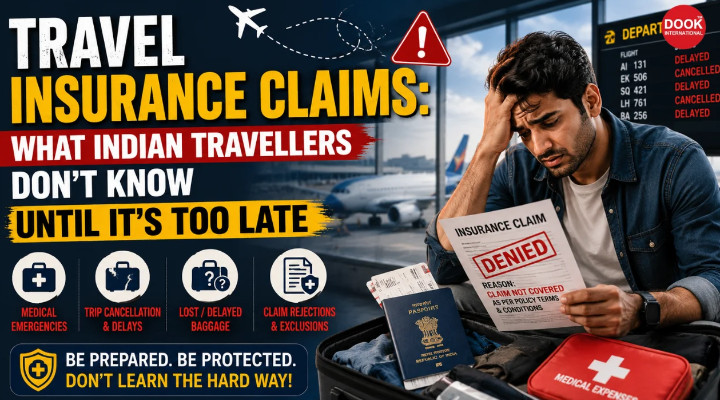
You bought the policy, paid the premium, and assumed the hard part was done. Then something went wrong abroad - a medical emergency, lost baggage, a cancelled flight, a stolen passport - and you filed a claim. Weeks later, a rejection email arrived citing a technicality you had never heard of.
This is not an unusual story for Indian travellers. The travel insurance market in India has grown significantly, but the gap between what travellers believe is covered and what insurers actually pay out remains wide — and it is almost always the result of procedural errors, not invalid claims.
Before your next trip, read Dook's guide on travel insurance for international trips to understand what to look for in a policy. This article covers the next step: what to do when you actually need to use that policy, and what happens if your claim is rejected.
Why Most Indian Travel Insurance Claims Fail — The Real Reasons
According to Insurance Samadhan, which handles real grievance data from Indian policyholders, most claim rejections happen due to exclusions or documentation errors — not because the claim itself was invalid. The most common causes in 2026:
| Sr No | Rejection Reason | What Actually Happens |
| 1 | Missing or late claim notification | Most policies require you to notify the insurer within 24-72 hours of an incident. Miss this window and your claim can be rejected outright - regardless of whether the underlying event was covered. |
| 2 | Undisclosed pre-existing condition | Any condition diagnosed or treated within 48 months before your policy start date counts as pre-existing. Insurers can reject claims even for seemingly unrelated incidents if an undisclosed condition existed. |
| 3 | Insufficient documentation | 35-40% of rejections in 2026 are document-related. Missing an airline Delay Report, a Property Irregularity Report (PIR), a police FIR, or original hospital bills is enough for rejection. |
| 4 | Policy exclusion misunderstood | Trip cancellation does NOT cover 'changed my mind' or 'work got busy.' Adventure sports injuries, voluntourism, and self-inflicted incidents are routinely excluded. |
| 5 | Negligence finding | Leaving a laptop bag unattended at a cafe counts as negligence. Leaving valuables in a checked bag (not carry-on) is often excluded. Insurers apply a 'reasonable care' standard strictly. |
| 6 | Baggage delay on return to India | Most policies cover baggage delay only on the outbound journey, not the return leg back to India. A delay on the way home is almost never claimable. |
| 7 | Buying insurance after booking, too late | If a named risk event (hurricane, airline strike, political situation) occurs before you buy the policy, you cannot claim cancellation for it — even if you buy the policy before your departure date. |
| 8 | Remote work and voluntourism void coverage | Working abroad — even briefly, even remotely — can void your tourist travel insurance. Voluntary work involving manual labour ('voluntourism') almost always falls into this exclusion. |
The Single Most Important Rule for Any Travel Insurance Claim in India Call your insurer's 24/7 emergency helpline the moment something goes wrong - before you pay a single bill, before you leave the hospital, before you file a police report, before anything. This one call creates a timestamp, activates cashless facilities if applicable, and gets you on record. Most policies require notification within 48-72 hours for medical emergencies and 24 hours for theft or accidents. Miss this window and the claim can be rejected entirely, regardless of everything else. |
What to Do and What Documents You Need — Claim by Claim
Different claim types require different documentation. The single most common cause of rejection — across all claim types — is arriving at the claims stage without the right paperwork. Here is exactly what each type needs:
Medical Emergency Abroad
| Step | Action Required |
| Immediately | Call insurer's 24/7 emergency helpline. Get a reference number. Do NOT pay the hospital bill until you have spoken to the insurer — cashless facility may be available if the hospital is in their network. |
| At the hospital | Get all bills in original (not photocopies). Get original admission and discharge card. Get consultation notes from the treating doctor. |
| Cashless vs Reimbursement | Cashless: insurer pays hospital directly (only at network hospitals). If unavailable, pay and claim reimbursement. For bills over USD 500, cashless is strongly preferred. |
| Documents required | Filled claim form | Policy copy | Passport + visa | Boarding passes | Original hospital bills with prescriptions | Doctor's consultation notes | Original admission/discharge card | Bank account details for NEFT |
| Settlement timeline | Bajaj General: 10 working days for NEFT if docs complete. Most insurers: 30-90 days for reimbursement claims. |
⚠️ Medical Claim Trap for Indians The 'emergency' definition is applied narrowly by insurers. A condition that could wait until you return to India will often be classified as non-emergency and rejected. Chronic condition management almost never qualifies. Treatment must be certified as medically necessary by the insurer's medical team — not just by your overseas doctor. If in doubt, call the helpline before you agree to non-urgent treatment. |
Lost or Delayed Baggage
| Step | Action Required |
| At the arrival airport - DO THIS FIRST | Before exiting through customs, go to the airline's baggage services desk and get a Property Irregularity Report (PIR). This is the single most critical document for any baggage claim. Leaving the airport without a PIR makes your baggage claim nearly impossible to process. |
| Baggage delay (for emergency purchases) | Keep all receipts for essential purchases (clothing, toiletries) made during the delay. Most policies reimburse essentials after a threshold delay (typically 12 hours). Keep the airline's official delay confirmation. |
| Lost baggage | Report to the airline's baggage tracing system. Get a written confirmation of the loss. Airlines must compensate you first — insurers pay the difference after airline liability is applied. You must submit proof of airline compensation (or refusal) with your insurance claim. |
| Documents required | PIR from airline | Policy copy | Passport + boarding passes | List of lost items with estimated values | Receipts for emergency purchases | Airline's written settlement or refusal letter | Claim form |
| Critical exclusion | Baggage delay on the RETURN leg back to India is almost universally excluded. Cover only applies on the outbound journey. Electronics and jewellery in checked baggage are typically excluded — always carry these in your cabin baggage. |
Trip Cancellation or Interruption
| Step | Action Required |
| Covered reasons ONLY | Hospitalisation of insured or immediate family member | Death of immediate family member | Natural disaster making destination inaccessible | Serious illness certified by a doctor. 'Changed my mind' or 'work got busy' or 'visa rejected' are NOT covered under standard policies. |
| Documentation is heavy | Medical certificate from treating doctor | Hospital admission records | Death certificate (if applicable) | Employer letter (if job loss is a covered event under your policy) | Proof of non-refundable bookings (airline, hotel receipts) |
| Airline and hotel refunds first | You must pursue refunds from airlines and hotels first. Insurance covers only the non-refundable portion after all other recovery is exhausted. Submit proof of refund attempts. |
| Key timing rule | You must buy travel insurance before the cancellation event occurs. If the event (illness, death, disaster) happens before you buy the policy, you cannot claim cancellation for it. |
Flight Delay
Most policies cover expenses for flight delays exceeding a threshold - usually 6 to 12 hours (check your specific policy). This includes meals and hotel accommodation.
• Critical document: An official Delay Report from the airline. A verbal announcement or departure board screenshot is insufficient. Ask the airline counter staff specifically for a written Delay Report or 'Delay Certificate.'
• Keep all receipts: Meals and hotel during the delay are reimbursable. Keep every receipt, no matter how small.
• Exclusions: Delays caused by events you knew about before travel (announced strikes, weather warnings) are typically excluded if you had prior knowledge.
Lost or Stolen Passport Abroad
• Step 1: File a police FIR (First Information Report) at the nearest police station in the destination country. This is non-negotiable - no FIR means no claim.
• Step 2: Contact the nearest Indian Embassy or Consulate for an Emergency Certificate or temporary travel document.
• Step 3: Inform your insurer's helpline and get a reference number.
• Documents: Police FIR copy | Emergency Certificate from Indian Embassy | Original passport number record | Claim form | Receipts for expenses incurred due to passport loss (additional hotel nights, emergency flights)
What Is NOT Covered in Travel Insurance — The Exclusions Indians Consistently Miss
| What Indians Assume Is Covered | What the Policy Actually Says |
| Any trip cancellation reason | Only specific listed reasons: hospitalisation, death of family member, natural disaster, serious illness. Not visa rejection, work, or change of mind. |
| Baggage delay on the way home | Almost universally excluded. Only outbound delay is covered. |
| Adventure sports injuries (bungee, skydiving, scuba) | Excluded under standard policies. Need an add-on rider specifically for adventure activities. |
| Working remotely during the trip | Can void tourist travel insurance entirely. Even brief remote work may trigger the exclusion. |
| Pre-existing condition treatment | Excluded unless specifically declared and covered by a pre-existing condition rider (usually at higher premium). |
| Self-inflicted injuries or alcohol-related incidents | Excluded universally. Public intoxication leading to injury is not covered. |
| Travelling against government advisories | Trips to countries under active Indian government travel advisory (Do Not Travel) are excluded. |
| Jewellery and electronics in checked bags | Most policies exclude high-value items from baggage cover unless in cabin baggage. |
If Your Travel Insurance Claim Is Rejected: The Full IRDAI Escalation Path
A rejected travel insurance claim is not final. India has a clearly defined, three-tier escalation system — all free — that gives policyholders genuine recourse. 57% of Insurance Ombudsman cases in FY 2023-24 were decided in favour of policyholders.
Tier 1: Insurer's Grievance Redressal Officer (GRO) — Day 1 to Day 15
• Get the rejection in writing. Demand a specific rejection letter citing the exact policy clause — 'Policy exclusion' alone is not sufficient. Insurers are obligated to specify clause references.
• Appeal to the GRO within 30 days. Every insurer must publish a Grievance Redressal Officer email and toll-free number on the policy document. Send a formal written appeal addressing each rejection reason point by point. Include any additional documentation you can provide. Send via registered post with acknowledgement.
• Timeline: Insurer must respond within 15 days. If no satisfactory response in 15 days, you gain the right to escalate.
Tier 2: Bima Bharosa Portal (IRDAI) — After 15 Days
• Portal: bimabharosa.irdai.gov.in — IRDAI's official grievance management platform.
• Eligibility: You must have first approached the insurer's GRO and either received an unsatisfactory response OR received no response within 15 days.
• What you need: Your GRO complaint reference number | The insurer's rejection letter | All supporting documents. Without the GRO reference number, the Bima Bharosa portal may reject your escalation.
• What IRDAI does: Bima Bharosa forwards the complaint to the insurer with a 15-day SLA and monitors resolution. IRDAI does not itself adjudicate but creates regulatory pressure.
• Important: Bima Bharosa does NOT ask for payments of any kind. Do not scan QR codes or use third-party links claiming to be Bima Bharosa.
Tier 3: Insurance Ombudsman — The Final Free Recourse
• Jurisdiction: 17 Ombudsman offices across India. Jurisdiction is determined by your address, not the insurer's. Find your office at cioins.co.in/Ombudsman.
• Claims limit: The Ombudsman can pass binding awards up to Rs. 50 lakh (increased from Rs. 30 lakh as of 2024). No advocate or legal fee needed.
• Filing deadline: Within 1 year of the insurer's repudiation or from end of the 30-day GRO window if the insurer did not respond.
• Process: Submit a written complaint with all documentation. The Ombudsman acts as a quasi-judicial body. Process takes 2-3 months. Success rate for legitimate claims with proper documentation is strong.
• Condition: No proceeding must be pending in any court, consumer forum, or arbitration on the same subject matter.
📋 Three-Tier Escalation at a Glance Step 1: File written appeal with Insurer's GRO (email + registered post). Reference: policy document for GRO contact. Timeline: 15-day insurer response SLA. Step 2: If unresolved, escalate to Bima Bharosa at bimabharosa.irdai.gov.in. Need: GRO reference number + rejection letter. Timeline: 15-day SLA from IRDAI. Step 3: Approach Insurance Ombudsman (cioins.co.in). Free. No lawyer needed. Binding awards up to Rs. 50 lakh. Timeline: 2-3 months. File within 1 year of rejection. |
What to Do Before You Travel — So You Never Need to Escalate
The best travel insurance claim is one you never have to fight for. Before every international trip, before the policy docs are filed away:
• Buy insurance the day you book flights — not the day before you fly. Events that occur before your purchase date are excluded from cancellation cover.
• Declare all pre-existing conditions fully — even if you think they are irrelevant. Non-disclosure voids claims even for unrelated incidents.
• Read the policy, not the brochure — the brochure shows benefits, the policy document shows exclusions. The exclusions are what matter when you claim.
• Save the 24/7 emergency helpline number in your phone — before you leave India. This number is on your policy document. Screenshot it.
• Keep digital copies of all travel documents — policy, passport, visa, hotel booking, flight tickets — in a cloud folder accessible offline.
• Understand your coverage limits — minimum USD 100,000 medical coverage is advisable for developed countries. US and Canada warrant USD 250,000 or higher — a single surgery in New York can cost ₹15-20 lakh.
For a full breakdown of what to look for when buying a policy, see Dook's guide on travel insurance for international trips — covering policy types, coverage amounts by region, and how to read the fine print before you sign.
Claim Documentation Master Checklist
| Claim Type | Critical Documents (in addition to claim form, policy copy, passport, tickets) |
| Medical Emergency | Original hospital bills + prescriptions | Doctor consultation notes | Original admission/discharge card | 24/7 helpline reference number |
| Lost/Delayed Baggage | Property Irregularity Report (PIR) from airline at arrival | Airline delay/loss confirmation letter | Receipts for emergency purchases | List of lost items with values |
| Trip Cancellation | Medical certificate / hospital records / death certificate | Proof of non-refundable bookings | Airline + hotel refund correspondence |
| Flight Delay | Official Delay Report / Delay Certificate from airline counter | All meal and hotel receipts during delay |
| Lost/Stolen Passport | Police FIR from destination country police | Indian Embassy Emergency Certificate | Record of original passport number |
| Personal Liability | Police report | Legal notices / correspondence received | Insurer notification reference (call helpline immediately) |
Planning Your Next International Trip?
Dook International builds international tour packages that take the documentation complexity out of travel — including visa guidance, travel insurance recommendations, and in-destination support if something goes wrong. Because the best travel emergency is one that never becomes a claim dispute.

 Admin
Admin 

















 Hassle-free booking and best price guaranteed
 24/7 support available
 Hand-picked tours & activities
 Free travel insurance
 sales@dooktravels.com
 +918368513675