




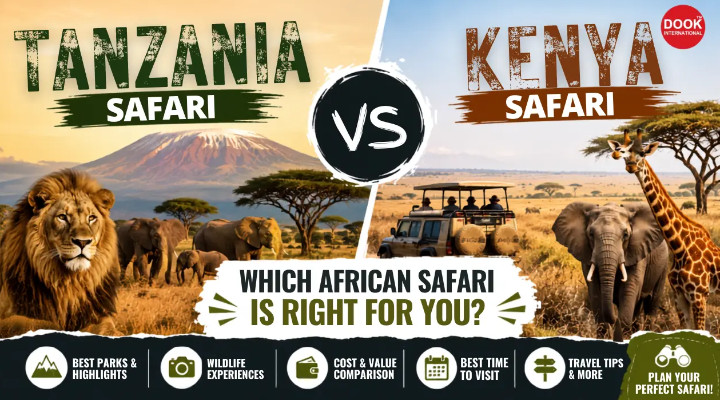
East Africa has two safari giants, and almost everyone planning their first trip eventually lands on the same question: Tanzania vs Kenya safari — which one should I actually book? Both countries sit within the same Serengeti-Mara ecosystem, share the Big Five, and host the Great Migration at different points in its annual cycle. Yet the on-the-ground experience — cost, crowd levels, logistics, and pace — differs enough that the "right" choice really does depend on who's travelling and what they want out of it.
This guide breaks down every factor that matters when planning a safari trip to East Africa, so you can decide with clarity rather than guesswork — and understand what to actually look for in safari tour packages once you've picked a direction.
The Quick Answer
If you only read one paragraph: Kenya is the stronger choice for first-time safari-goers, shorter trips (5–7 days), tighter budgets, and travellers who want easy logistics with a major international airport a short drive from the parks. Tanzania is the stronger choice for travellers with 7+ days, a preference for wilderness immersion over convenience, and a desire to combine safari with a Zanzibar beach extension. Neither is objectively better — they solve for different priorities. If time and budget allow, combining both in a 10–14 day itinerary is widely considered the most complete East African safari experience.
1. Wildlife and Parks: Density vs. Scale
Both countries are Big Five destinations (lion, leopard, elephant, buffalo, rhino), and both sit inside the same wildlife corridor, so species-wise, you won't be short-changed in either.
Kenya's signature reserve is the Masai Mara — relatively compact at around 1,510 km², but it delivers some of the highest predator densities anywhere in Africa. Beyond the Mara, Kenya offers genuinely varied landscapes: Amboseli for elephant herds against Kilimanjaro's backdrop, Samburu's drier north for species you won't find further south (Grevy's zebra, reticulated giraffe, gerenuk), and Nairobi National Park, unusually, within sight of a city skyline.
Tanzania has significantly more protected land — its national parks alone cover over 38,000 km², compared to roughly 8,000 km² of Kenya's major reserves. The Serengeti alone is close to 15,000 km², larger than all of Kenya's headline reserves combined. That scale translates into more habitat variety, longer wildlife corridors, and — practically speaking — more space between your vehicle and the next one at a sighting. The Ngorongoro Crater, a collapsed volcanic caldera with all Big Five living within its walls year-round, is Tanzania's standout advantage and has no direct Kenyan equivalent.
In short: Kenya wins on predator density and landscape variety per day; Tanzania wins on scale, habitat diversity, and a lower-crowd feel per sighting.
2. The Great Migration: Timing Is Everything
The Great Migration is a single continuous cycle that moves between both countries, so this is really a question of when you're travelling, not which country "has" it.
Tanzania hosts the migration for roughly 9–10 months of the year, including the wildebeest calving season in the southern Serengeti (January–March) and the herds moving north through the year.
Kenya's Masai Mara hosts the dramatic Mara River crossings for a shorter window — typically July to October — which is also peak tourist season and peak pricing.
If your travel dates are fixed and fall between July and October, Kenya's river crossings are the bigger draw. If you're flexible or travelling outside that window, Tanzania's longer migration presence and the calving season (a favourite for predator action) make it the stronger pick.
3. Cost: What a Safari Actually Costs in 2026
This is usually the deciding factor once wildlife preferences are similar. As a rough 2026 benchmark for a mid-range, per-person-sharing safari:
Kenya | Tanzania | |
6-day mid-range safari | $2,500 – $3,500 | $3,500 – $5,000 |
Daily park entry fees | ~$100 – $200 | ~$110 – $160 + vehicle fees |
Luxury safaris (per night) | $800 – $1,500+ | $800 – $1,500+ |
Tanzania typically runs 20–30% more expensive than a comparable Kenya itinerary. The premium comes from higher park and concession fees, more remote lodge locations (which push up logistics costs), and a heavier reliance on internal bush flights, each of which can add $300–500 per segment. Kenya's proximity to Nairobi keeps road transfers cheaper and more frequent, and a larger volume of lodges and operators keeps competition — and prices — more favourable for budget-conscious travellers.
At the ultra-luxury end, the two countries are roughly comparable, since exclusivity rather than logistics drives pricing at that tier.
4. Crowds and the Feel of the Safari
Kenya receives more total visitors annually, and its smaller parks mean more vehicles can congregate at a single sighting — most noticeably in the Masai Mara during peak migration months. This doesn't mean Kenya feels overcrowded by global standards (there are no large resort-style hotels in either country), but it is a real, noticeable difference compared to Tanzania.
Tanzania's larger park areas and lower visitor density per square kilometre generally translate into a more remote, exclusive feel — fewer vehicles at sightings and a stronger sense of genuine wilderness, which is often the single biggest reason travellers choose to pay Tanzania's premium.
5. Accessibility and Logistics
Kenya has the logistical edge for anyone short on time. Nairobi's Jomo Kenyatta International Airport is a major global hub with strong direct connectivity, and several parks — including Nairobi National Park — are close enough to the capital for same-day game drives. This makes Kenya especially practical for 5–6 day trips or travellers combining safari with a business trip or stopover.
Tanzania's parks are more remote relative to its main gateway airports (Kilimanjaro and Dar es Salaam), and multi-park itineraries often require internal flights between the Serengeti, Ngorongoro, and other circuits. It's more logistically demanding, but that same remoteness is precisely what preserves the wilderness feel travellers pay for.
6. Beach Extensions
This one is a clear differentiator: Tanzania has Zanzibar, a UNESCO World Heritage-listed archipelago with white-sand beaches, Stone Town's historic architecture, and excellent diving — a near-seamless extension after a northern circuit safari. Kenya's coastal options (Diani Beach, Lamu) are genuinely lovely but sit in a different tier of global recognition and typically require a longer detour from the main safari circuit.
If a beach add-on is part of your plan, it meaningfully tips the scale toward Tanzania.
7. Visa Requirements for International Travellers (Including Indians)
Entry requirements differ meaningfully between the two countries and are worth checking well before booking flights:
Kenya now operates a mandatory Electronic Travel Authorisation (eTA) for almost all nationalities, including Indian citizens. It must be applied for online in advance (ideally at least 3–5 business days before travel), costs roughly $30–34 USD, and is valid for a single entry of up to 90 days. Visa-on-arrival is no longer available for Indian passport holders.
Tanzania requires a standard tourist visa (the "Ordinary Visa"), obtainable either online through the official Tanzania Immigration e-Visa portal or, in many cases, on arrival at the airport. The fee is typically around $50 USD for a single-entry visa valid up to 90 days.
If you're combining both countries in one trip, note that a Kenyan eTA can sometimes be reused on return if you travel directly to/from an East African Community country like Tanzania — but this depends on your exact routing, so it's worth confirming with your operator.
Always verify current fees and processing times on the official immigration portals before travel, as both systems have changed in recent years and can change again.
8. Who Should Choose Which
Choose Kenya if you:
Are on your first safari and want a shorter, simpler trip (5–7 days)
Have a tighter budget
Want to time your trip specifically around the Mara River crossings (July–October)
Value shorter transfers and strong flight connectivity via Nairobi
Choose Tanzania if you:
Have 7–10+ days available
Want the most immersive, lower-crowd wilderness experience
Want to see the Ngorongoro Crater and/or extend the trip with Zanzibar
Are less price-sensitive and prioritise scale and exclusivity over convenience
Choose both if you:
Have 10–14 days and want the definitive East Africa experience — a popular combination is 3–4 nights in the Masai Mara paired with 3–4 nights across the Serengeti and Ngorongoro Crater.
9. Choosing the Right Safari Tour Packages
Once you've picked a direction (or decided to combine both), the next decision is how much to plan yourself versus how much to leave to an operator. Good safari tour packages typically bundle park fees, accommodation, an experienced guide, game drives, and internal transfers or flights into a single itinerary — which matters more in East Africa than in most destinations, since self-driving through national parks isn't practical or, in many cases, permitted for independent international travellers.
When comparing packages, look closely at:
Vehicle-sharing policy — private vehicles cost more but avoid compromising on pace with strangers.
Accommodation style — permanent lodges, semi-permanent tented camps, and mobile camps all offer very different experiences at different price points.
Inclusions — park fees, conservancy fees, and government levies can be significant; confirm what's included versus billed separately.
Group size — smaller group safaris tend to get closer, quieter sightings than larger shared-vehicle tours.
Operator experience specifically in your chosen country — a Kenya specialist and a Tanzania specialist are not always the same operator, and local expertise shows up in itinerary quality and lodge selection.
Given that peak-season lodges (especially well-known ones) fill up 6–12 months in advance, starting the planning process early is one of the highest-leverage things you can do when planning a safari trip, regardless of which country you choose.
Final Thoughts
There's no wrong answer in the Tanzania vs Kenya safari debate — both deliver world-class wildlife experiences that people remember for the rest of their lives. Kenya rewards travellers who want efficiency, value, and predator-dense game drives on a shorter timeline. Tanzania rewards those willing to invest more time and budget into a larger, quieter, more immersive wilderness — with the added bonus of Zanzibar at the end. If you can carve out the time, combining both remains the gold standard for a first East African safari.

 Admin
Admin 
























 Hassle-free booking and best price guaranteed
 24/7 support available
 Hand-picked tours & activities
 Free travel insurance
 sales@dooktravels.com
 +918368513675