








You order the vegetable soup. The waiter confirms it has no meat. You eat it, enjoy it, and it is only later — when you mention it to a local — that you discover the broth was made with fish stock. Or you order a green salad in Italy and realise, mid-bite, that the dressing contains anchovies. Or you eat what appeared to be a pure potato dish in Japan and discover it was simmered in dashi — a broth made from dried bonito (tuna flakes).
For Indian vegetarians, Jains, and halal travellers, this is the unspoken reality of international food travel. The challenge is not finding food labelled 'vegetarian' or 'no pork.' The challenge is navigating an invisible world of cooking techniques, hidden base ingredients, and cross-cultural definitions of what 'vegetarian' actually means — definitions that differ radically from the Indian understanding.
In Thailand, fish sauce is an ingredient in virtually every savoury dish — including vegetable curries, pad Thai, and most soups. In Japan, dashi (broth made from dried fish and seaweed) is the foundation of miso soup, ramen broth, soba noodle stock, and most Japanese sauces. In France and Italy, animal rennet is used to produce authentic Parmesan and many other cheeses. In the UK, gel capsule supplements and many desserts contain gelatin derived from pig or cow bones. In Mexico, traditional corn tortillas and refried beans are often cooked with lard.
None of these is secret. None is malicious. They are simply the result of food cultures that evolved without the concept of Indian-style vegetarianism — and they represent a genuine challenge for the 300+ million Indian travellers who maintain strict dietary restrictions and are now planning international tours in record numbers.
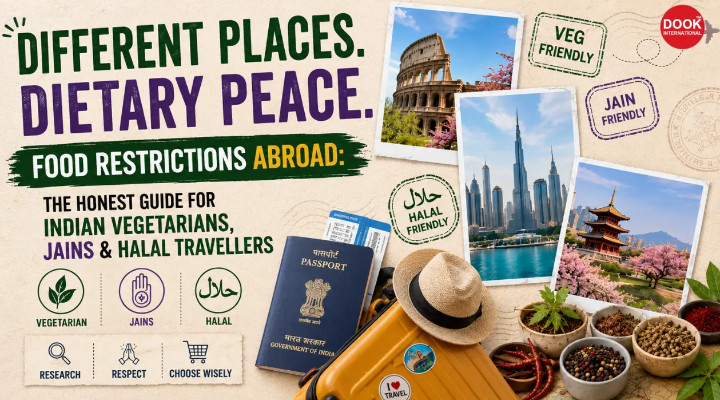
This guide is the one that nobody else writes honestly. Not a cheerful 'here are vegetarian-friendly countries' list — a real, specific, country-by-country breakdown of what Indian vegetarians, Jains, and halal travellers actually face abroad in 2026, with practical tools, airline meal codes, food allergy cards, apps, and emergency protocols.
Understanding the Three Dietary Profiles — Vegetarian, Jain, and Halal
Before the country-by-country guide, it is important to establish clearly what each dietary profile requires — because abroad, the definitions are frequently misunderstood by restaurant staff, food labelling, and even well-meaning guides.
Indian Vegetarian (Hindu Vegetarian)
The broadest Indian dietary category. Indian vegetarians do not eat meat, poultry, or fish. Most Indian vegetarians do consume dairy (milk, butter, paneer, ghee, yoghurt) but do not eat eggs. This profile is different from Western 'vegetarian' (which often includes eggs) and different from 'vegan' (which excludes all dairy).
• What is avoided: All meat, poultry, fish, seafood, and eggs
• What is consumed: Dairy products, vegetables, grains, pulses, fruits, nuts
• Key misconception abroad: Western 'vegetarian' menus frequently include eggs. In Europe, a 'vegetarian' pizza will typically have eggs in the dough. In the USA, a 'vegetarian burger' may be bound with egg white.
• Airline meal code: AVML — Asian Vegetarian Meal. Spiced, Indian-style vegetarian food may include dairy. Request this when booking international flights.
Jain Vegetarian
Jain dietary practice is the most restrictive mainstream Indian dietary system. In addition to avoiding all meat, fish, and eggs, Jain vegetarians avoid root vegetables — any vegetable that grows underground or requires the whole plant to be uprooted to harvest — because uprooting harms the entire plant and potentially microorganisms in the soil.
• Root vegetables avoided: Onion, garlic, potato, carrot, beetroot, radish, turnip, ginger, leek, spring onion, shallots, and in many interpretations, mushrooms
• What is consumed: Above-ground vegetables, grains, pulses, dairy, fruits
• Key challenge abroad: Onion and garlic are foundational ingredients in the vast majority of world cuisines — Italian, French, Thai, Chinese, Turkish, Mexican, and Middle Eastern. A Jain traveller will find that nearly every restaurant dish in the world contains one or both. This is the most practically challenging Indian dietary restriction to manage internationally.
• Airline meal code: VJML — Vegetarian Jain Meal. No root vegetables, no onion, no garlic, no mushrooms, no fermented foods, no eggs. Request at the time of booking.
Jain Travellers: A practical tip used successfully by experienced Jain travellers abroad: describe restrictions as a food allergy rather than a dietary preference. Internationally, 'allergy' triggers kitchen-level caution and specific ingredient checking. 'Dietary preference' is frequently interpreted loosely. Saying 'I am allergic to onion and garlic' produces more careful kitchen responses than 'I don't eat onion and garlic for religious reasons.'
Halal Dietary Requirements
Halal dietary law for Muslim travellers is governed by Islamic principles that prohibit pork and pork derivatives, alcohol (including alcohol used in cooking), blood, and any animal product not slaughtered according to Islamic rites. Halal travellers can eat all vegetables, fruits, grains, seafood, and properly certified halal meat.
• What is avoided: Pork and all pork derivatives (gelatin from pork, lard), alcohol in any form (including wine-based cooking sauces, beer batters), blood, non-halal-certified meat
• Hidden concerns: Gelatin (often pork-derived) in desserts, gummy sweets, marshmallows, and some yoghurts. Lard in pastry and bread in some countries. Alcohol in cooking sauces, wine reduction sauces, beer-battered fish and chips, risotto cooked with wine. Rennet in cheese (may be animal-derived).
• Airline meal code: MOML — Muslim Meal. Halal-certified meat and ingredients, no pork or pork derivatives, no alcohol. Available on most international airlines.
Halal Travellers: In destinations with limited halal meat availability (Japan, rural Europe, parts of East Asia), the practical approach is to default to seafood, eggs, and vegetarian dishes — which are halal by nature — rather than attempting to verify halal certification on meat dishes at local restaurants. Seafood is almost universally permissible and widely available.
The Hidden Ingredient Danger List — What Indian Travellers Don't Know Until It's Too Late
This is the most important section of this guide. The following ingredients appear in dishes that look vegetarian, halal, or Jain-safe on menus and labels — but are not. Every Indian traveller planning an international tour must know this list before departure.
Fish Sauce (Nam Pla / Nuoc Cham / Prahok)
Fish sauce is a fermented fish liquid used as a foundational seasoning across Southeast Asian cuisine — Thailand, Vietnam, Cambodia, Laos, and Myanmar. It is clear or pale amber in colour, has no visible fish, and adds a savoury depth (umami) to dishes without tasting distinctly 'fishy' when cooked.
• Where it appears: Thai curries (including vegetable curries), pad Thai, most Thai stir-fries, Vietnamese pho broth, Vietnamese dipping sauces (nuoc cham), fried rice, noodle soups, spring roll dipping sauce, and almost every savoury Thai and Vietnamese dish
• What it looks like on a menu: Nothing. Fish sauce is a cooking ingredient, not a listed topping. A dish described as 'vegetable stir-fry' in Thailand will almost certainly have been made with fish sauce unless the restaurant caters specifically to vegetarians.
• How to avoid it: In Thai: 'mai sai nam pla' (no fish sauce). In Vietnamese: 'khong cho nuoc mam' (no fish sauce). Seek restaurants displaying a vegetarian symbol (green leaf or the Thai jay symbol — a yellow flag with red lettering) which indicates genuinely fish-sauce-free cooking.
• Severity for Indian vegetarians: High — this is the single most frequent hidden non-vegetarian ingredient encountered by Indian vegetarians in Southeast Asia
Dashi (Japanese Fish and Seaweed Broth)
Dashi is the foundational stock of Japanese cuisine — used in miso soup, ramen broth, udon and soba noodle broth, Japanese omelette (tamagoyaki), simmered vegetable dishes (nimono), and most Japanese sauces. Standard dashi is made from katsuobushi (dried bonito tuna flakes) and kombu seaweed. Vegetarian dashi made from only kombu exists, but is less common in standard restaurant cooking.
• Where it appears: Miso soup, all ramen broths (including seemingly vegetable ramen), Japanese noodle soups, Japanese omelette, most Japanese cooked vegetable dishes, tonkatsu sauce
• The miso soup trap: Miso soup looks vegetarian — it appears to be just miso paste in water with tofu. The broth base is almost always fish dashi. This catches most Indian vegetarian tourists in Japan on the first meal.
• How to identify safe options: Look for shojin ryori (Buddhist temple cuisine) — entirely vegetarian without dashi. Kombu dashi-based dishes. Ask restaurants specifically: 'katsuo nashi?' (without bonito?) or carry a printed Japanese dietary restriction card.
• Severity: Very high in Japan — affects virtually every restaurant dish including those described as vegetarian
Gelatin
Gelatin is derived from boiled animal bones, skin, and connective tissue — almost always from pigs or cows. It is odourless, colourless, and tasteless, making it invisible in food. Gelatin is used as a setting agent, thickener, and stabiliser across a wide range of food products worldwide.
• Where it appears: Gummy bears and all gummy sweets (the entire category), marshmallows, panna cotta and many dessert jellies, some yoghurts (as a stabiliser), some ice creams, aspic (savoury jelly), some medications (gel capsules), some cheeses (as a coating)
• On wine bottles: Gelatin, isinglass (fish bladder protein), and egg white are used as fining agents to clarify wine — they are filtered out before bottling and therefore do not appear on labels. Most mainstream wines are not strictly vegetarian by this standard.
• How to check: Look for 'gelatine' or 'E441' in ingredients lists. In Europe, food manufacturers are required to label gelatin clearly. In the USA, 'gelatin' must appear in the ingredients list. Products labelled 'suitable for vegetarians' or 'vegan' will not contain gelatin.
• Severity: Moderate — primarily affects packaged confectionery, desserts, and capsule medications
Rennet in Cheese
Rennet is an enzyme used to coagulate milk into cheese. Traditional animal rennet is derived from the stomach lining of calves, pigs, or other young ruminants. Most mass-market Western cheeses now use microbial or vegetarian rennet, but authentic versions of many European cheeses are legally required to use animal rennet.
• Cheeses that legally require animal rennet: Parmigiano-Reggiano (authentic Parmesan — EU law mandates traditional production including animal rennet), Pecorino Romano, Grana Padano, Gruyère AOP, Comté AOP, Manchego DOP
• What this means practically: A genuine Italian Parmesan grated on your pasta at an Italian restaurant contains animal rennet. A supermarket 'Parmesan-style' cheese may use vegetarian microbial rennet.
• How to navigate: In supermarkets abroad, look for 'suitable for vegetarians' label — this guarantees microbial or vegetarian rennet. In restaurants, ask if the cheese used is 'vegetarian rennet' (this question will be understood in most European countries). Indian vegetarians comfortable with dairy but not animal slaughter products should note this distinction.
• Severity: Moderate — primarily relevant in Italy, France, and Spain where authentic DOP cheeses are widely used
Lard in Bread, Pastry, and Refried Beans
Lard is rendered pig fat used as a cooking fat and pastry ingredient. It is colourless and flavourless in many applications, making it invisible in finished dishes.
• Where it appears: Traditional Mexican flour tortillas (corn tortillas are typically lard-free; flour tortillas often are not), traditional refried beans (frijoles refritos are often cooked with lard), many European pastry doughs, croissants and pain au chocolat in some bakeries, traditional British pies, some bread recipes
• How to check: In supermarkets, look for 'manteca' (lard, in Spanish-speaking countries) in ingredients. In restaurants in Mexico, ask if the tortillas are corn (maiz — typically lard-free) or flour (harina — may contain lard). Ask if the beans are 'sin manteca' (without lard).
• Severity: Moderate — primarily relevant in Mexico and traditional European bakeries
Worcestershire Sauce and Caesar Dressing
Two condiments that appear widely in Western restaurants and supermarkets, both containing fish, are frequently used in dishes that appear vegetarian.
• Worcestershire sauce: Contains anchovies. Used in burgers, pasta sauces, Bloody Mary cocktails, marinades, steak sauces, and as a flavour enhancer in many Western dishes. Vegetarian versions exist (labelled as such), but the standard version is not vegetarian.
• Caesar salad dressing: Traditional Caesar dressing contains anchovy paste. Most salads described as 'Caesar salad' in restaurants worldwide use traditional dressing unless specifically labelled as vegetarian Caesar.
• How to avoid: Ask specifically about these condiments when ordering salads, burgers, or pasta in Western restaurants. Vegetarian versions are available, but not the default.
Alcohol in Cooking
For halal travellers, the use of alcohol in cooking — including wine reductions, beer batters, and brandy flambé — is a significant concern in European and Western cuisine. Cooking does not fully eliminate alcohol content — studies show that 5–85% of alcohol remains, depending on cooking method and duration.
• Where it commonly appears: French coq au vin (chicken in wine), boeuf bourguignon (beef in wine), Italian risotto (typically cooked with white wine), beer-battered fish and chips in the UK and Ireland, tiramisu (made with marsala wine and sometimes rum), Christmas pudding and fruitcake (typically soaked in brandy), flambéed dishes in French restaurants
• How to navigate: Ask restaurants whether dishes are cooked with wine or alcohol — most kitchens are transparent about this. In halal-certified restaurants (look for halal certification plaques), alcohol is never used in cooking. Mediterranean cuisines (Lebanese, Turkish, Middle Eastern) and South Asian restaurants abroad almost always cook without alcohol.
• Severity for halal travellers: High in France, Italy, and Western European restaurants — lower in Southeast Asia, the Middle East, and South Asian restaurants
Carmine (E120) — The Hidden Insect Dye
Carmine, also labelled E120, cochineal, or natural red 4, is a red food colouring derived from crushed cochineal beetles. It is used in red-coloured food and drink products, including fruit juices, yoghurts, red confectionery, some lipsticks, and some medications.
• Where it appears: Red-coloured yoghurts, fruit juices with a deep red colour (particularly strawberry and raspberry), red candies and confectionery, some ice creams, certain medications and supplements
• How to check: In the EU, carmine must be labelled as 'E120' or 'cochineal' or 'carmine' or 'natural red 4' in ingredients lists. Look for these terms on packaging when purchasing red-coloured food and drink products. Products labelled vegan will not contain carmine.
• Severity: Low to moderate — primarily affects packaged food and drinks rather than restaurant meals
Country-by-Country Food Safety Guide for Indian Dietary Restrictions (2026)
Here is an honest destination-by-destination guide for the most popular international tour destinations for Indians:
Japan — Most Challenging for Indian Vegetarians and Jains
Japan is the most challenging country in the world for Indian vegetarians and Jains. The food culture is built around dashi (fish broth), and vegetarian-labelled food frequently contains fish derivatives. Jain requirements (no onion, no garlic) eliminate almost every restaurant dish.
• Vegetarian safety rating: Difficult — requires active research and specific restaurant selection
• Jain safety rating: Very difficult — onion and garlic are in almost all non-Buddhist cuisine
• Halal safety rating: Moderate — dedicated halal restaurants exist in Tokyo, Osaka, and Kyoto; seafood is widely available
• Safe options: Shojin ryori (Buddhist temple cuisine — entirely vegan and typically onion/garlic-free), tofu restaurants, dedicated vegetarian restaurants in major cities, Indian restaurants in Tokyo's Nishi-Kasai area
• Key app: HappyCow (vegetarian/vegan restaurant finder), Halal Gourmet Japan
• Must carry: Japanese dietary restriction card — available as a printable PDF from the Japan Tourism Agency
Thailand — Moderate for Vegetarians, Good With the Right Phrase
Thailand is manageable for Indian vegetarians if you know the right approach. The Thai Buddhist vegetarian (jay) system produces entirely fish-sauce-free, egg-free cooking. Look for yellow flag with red lettering (jay symbol) outside restaurants.
• Vegetarian safety rating: Moderate — manageable with the jay system
• Jain safety rating: Difficult — onion and garlic are in virtually all Thai dishes; Buddhist jay restaurants may be the only option
• Halal safety rating: Good in tourist areas and southern Thailand — halal restaurants widespread in Bangkok and Phuket
• Safe phrases: 'Jay' (vegetarian/vegan in Buddhist Thai context), 'mai sai nam pla' (no fish sauce), 'mai sai phet' (not spicy — for those with spice-related issues), 'mai sai nuea sat' (no meat)
• Best options: Jay restaurants (yellow flag symbol), Indian restaurants in Bangkok, southern Thai Muslim restaurants for halal
Vietnam — Challenging but Improving
Vietnamese cuisine uses fish sauce (nuoc cham) and shrimp paste extensively. However, Vietnam has a strong Buddhist vegetarian tradition — rice paper rolls with tofu, com chay (Buddhist vegetarian restaurants), and vegetarian pho are increasingly available.
• Vegetarian safety rating: Moderate — Buddhist vegetarian restaurants are safe; standard restaurants require careful ordering
• Jain safety rating: Very difficult — onion, garlic, and spring onion are foundational Vietnamese flavours
• Halal safety rating: Moderate — halal restaurants exist in Ho Chi Minh City and Hanoi; Cham Muslim communities in the south operate halal food establishments
• Safe phrases: 'An chay' (vegetarian), 'khong cho nuoc mam' (no fish sauce), 'khong co thit' (no meat)
Europe (France, Italy, Spain) — Good Overall With Specific Traps
Western Europe is generally vegetarian-friendly at a broad level — menus are clearly labelled and vegetarian options are widely available in cities. The specific traps are rennet cheese, gelatin-based desserts, and the occasional use of meat stock in 'vegetable' soups.
• Vegetarian safety rating: Good in cities — EU allergen labelling laws (14 major allergens) and widespread vegetarian menu sections provide solid protection
• Jain safety rating: Moderate to difficult — onion and garlic are in virtually all Mediterranean cooking; explaining restrictions to kitchen staff is essential
• Halal safety rating: Moderate — halal restaurants are widespread in Paris, London, Barcelona, and all major European cities due to large Muslim populations; alcohol in cooking is the main concern at non-halal establishments
• EU Allergen Law: Under EU Regulation 1169/2011, restaurants and food manufacturers must declare 14 major allergens, including celery, gluten, milk, eggs, fish, and peanuts. This law provides strong protection for travellers with medically confirmed food allergies — note that religious dietary restrictions are not covered by the same legal framework.
• Cheese guidance: In Italy, ask for 'formaggio vegetariano' (vegetarian cheese). Supermarket cheeses labelled 'suitable for vegetarians' use microbial rennet.
Turkey — Very Good for Indian Dietary Needs
Turkey is one of the most naturally compatible international destinations for Indian dietary requirements. Turkish cuisine has extensive vegetarian traditions (meze culture, vegetable dishes, lentil soups, bread culture) and the large Muslim population means halal food is the default, not the exception.
• Vegetarian safety rating: Very good — extensive vegetarian dishes in Turkish cuisine
• Jain safety rating: Moderate — onion and garlic are common, but restaurants typically respond well to restriction requests
• Halal safety rating: Excellent — Turkey is an overwhelmingly Muslim country; virtually all restaurants serve halal food as standard; pork and alcohol are absent from most establishments
• Safe options: Meze plates (mostly vegetable-based), lentil soup, gözleme with cheese or spinach, Turkish breakfast spread, çiğ köfte (vegan spiced bulgur), hummus and bread
Malaysia and Singapore — Best Overall for Indian Dietary Diversity
Malaysia and Singapore offer the most naturally diverse and accessible food environments for all three Indian dietary profiles. Both countries have large Indian communities (Tamil, Punjabi, Gujarati) whose food is widely available. Both have large Muslim populations with comprehensive halal food infrastructure.
• Vegetarian safety rating: Excellent — Indian vegetarian restaurants, Hindu temple food stalls, and Chinese vegetarian Buddhist restaurants throughout both countries
• Jain safety rating: Good — particularly in areas with Gujarati communities; some Indian restaurants offer Jain menus
• Halal safety rating: Excellent — halal certification is mandatory for Muslim-operated food businesses; widespread halal signage makes identification straightforward
• Best resources: MUIS halal certification (Singapore), JAKIM halal certification (Malaysia) — look for these on restaurant doors and menus
Middle East (UAE, Saudi Arabia, Oman) — Excellent for Halal, Good for Vegetarians
The Middle East is the safest region for halal travellers — halal is the default standard across all food establishments. Indian vegetarian food is also widely available due to large Indian expat communities.
• Vegetarian safety rating: Very good — large Indian vegetarian communities mean extensive vegetarian options
• Jain safety rating: Moderate — Indian restaurants in UAE frequently offer Jain menus; general restaurants require careful ordering
• Halal safety rating: Excellent — halal is legally mandated across the region; pork is either banned or sold only in specially licensed outlets for non-Muslim expats
IATA Airline Meal Codes — What to Request Before Every International Flight
Every major international airline uses standardised four-letter IATA (International Air Transport Association) meal codes to prepare special meals for passengers with dietary requirements. These must be requested at the time of booking or at least 24–48 hours before departure — they cannot be requested at the airport.
• AVML — Asian Vegetarian Meal: Spiced, Indian-style vegetarian food. May include dairy. No meat, fish, or eggs. The standard choice for Hindu Indian vegetarians on international flights.
• VJML — Vegetarian Jain Meal: Strictly Jain. No meat, fish, eggs, dairy products from animal rennet, root vegetables (onion, garlic, potato, carrot, beetroot, ginger), or mushrooms. The correct meal code for Jain travellers.
• MOML — Muslim Meal: Halal-certified meat and ingredients. No pork or pork derivatives. No alcohol. The correct meal code for halal travellers.
• VGML — Vegan Meal: No meat, fish, eggs, or dairy. Western-style vegan preparation — grain bowls, steamed vegetables, pasta. Use as a backup if AVML is unavailable, though it lacks Indian spicing.
• HNML — Hindu Meal: Caution: this is NOT vegetarian. HNML is a non-vegetarian meal that excludes beef and pork but includes chicken, lamb, or fish with Indian spices. Many Indians mistakenly request this code, thinking it is vegetarian.
Watch Out: The most common airline meal mistake made by Indian vegetarians is requesting HNML (Hindu Non-Veg) instead of AVML (Asian Vegetarian). HNML contains chicken and fish. Always request AVML for Indian-style vegetarian. Jain travellers must explicitly request VJML — AVML may contain onion and garlic.
Pro Tip: Request your special meal at the time of booking — not closer to departure. Special meals are prepared in limited quantities, and last-minute requests (within 24 hours) may not be fulfilled. If you booked through a travel agent or tour operator, ask them to confirm the meal code has been added to your booking with the airline.
Essential Tools and Apps for Indian Dietary Restrictions Abroad
• HappyCow (happycow.net): The world's most comprehensive vegetarian and vegan restaurant finder. Available as app and website. Lists vegetarian, vegan, and veg-friendly restaurants in over 180 countries. Essential download before any international trip.
• Google Translate (with offline language packs): Download offline language packs for your destination before departure. Use the camera translation feature to read ingredients on packaged food and menus in foreign scripts. Essential for Japan, South Korea, and non-Latin-script countries.
• Dietary Restriction Cards — Equal Eats / AllergyFX: Print or digital cards in 50+ languages explaining your specific dietary restrictions clearly to restaurant kitchen staff. Available for vegetarian, vegan, Jain, halal, and allergy profiles. Far more effective than attempting to explain restrictions verbally across a language barrier.
• Barnivore (barnivore.com): For halal travellers and vegetarians who want to verify whether specific wine, beer, or spirits use animal-derived fining agents (gelatin, isinglass). Searchable database of alcohol products with production method information.
• Halal Trip (halaltrip.com): Comprehensive halal travel platform — restaurant finder, halal hotel search, prayer time locator, and destination guides for halal travellers. Available as app and website.
• The Fork / Resy: Restaurant booking platforms in Europe that allow dietary preference filtering — useful for pre-booking restaurants with confirmed vegetarian and halal menus.
What to Do if You Have a Food Allergy Emergency Abroad
This section applies specifically to Indian travellers with medically confirmed food allergies — not dietary preferences. If you carry an EpiPen (adrenaline auto-injector) for anaphylaxis to nuts, shellfish, dairy, gluten, or other allergens, international travel requires specific preparation beyond dietary preference management.
1. Carry a medical letter from your doctor — Before any international tour, get a letter from your allergist or GP on clinic letterhead confirming your allergy diagnosis, the medications you carry (including EpiPen), and why they are medically necessary. This letter is required if airport security questions your EpiPen or other medication.
2. Carry your EpiPen in hand luggage — Never pack your EpiPen in checked baggage. Temperature extremes in aircraft holds can damage the medication. Carry it in your carry-on bag. Most airlines allow medical devices including EpiPens in cabin bags — confirm with your airline before travel.
3. Buy international health insurance with allergy cover — Standard travel insurance for international tours covers emergency medical treatment including anaphylaxis reactions abroad. However, confirm that your policy explicitly covers emergency treatment for pre-existing allergies. Some international health insurance policies exclude pre-existing conditions unless specifically declared and an additional premium paid. Anaphylaxis treatment (emergency room, epinephrine administration, observation) can cost ₹2,00,000–₹8,00,000 in the USA and ₹80,000–₹3,00,000 in Europe without insurance.
4. Learn the local emergency number — In the EU the universal emergency number is 112. In the USA and Canada it is 911. In Japan it is 119 (ambulance). In Australia it is 000. In UAE it is 999. Save the emergency number for your destination in your phone before departure.
5. Register with your insurer's 24/7 emergency line — Your international health insurance or travel insurance policy includes a 24/7 international emergency assistance line. Save this number in your phone — this is the number to call for cashless hospitalisation authorisation in a medical emergency abroad.
6. Carry your allergen information in the local language — Use an Equal Eats or AllergyFX printed card in the destination country's language. In Japan, the Japan Tourism Agency provides official free downloadable allergen cards in Japanese for common allergen profiles.
International Health Insurance Note: Travel insurance for international tours and international health insurance are related but different products. Travel insurance covers emergency medical treatment during a specific trip. International health insurance is an annual policy covering ongoing medical needs, including recurring conditions. For Indian travellers with serious food allergies planning multiple international tours per year, an annual travel insurance policy (₹5,000–₹15,000 per year) is significantly more cost-effective than buying individual trip policies and ensures continuous allergy emergency cover.
Pre-Departure Checklist for Indian Dietary Restriction Travellers
Before You Leave India
• Request the correct IATA airline meal code (AVML / VJML / MOML) at the time of booking — not the day before departure
• Download HappyCow, Google Translate (with offline packs), and HalalTrip as appropriate for your profile
• Print dietary restriction cards in the destination language from Equal Eats or AllergyFX
• For medically confirmed food allergies: get a doctor's letter, ensure your EpiPen is in hand luggage, and buy international health insurance with allergy emergency cover
• Pack a small supply of Indian snacks, instant food packets, or ready-to-eat options for destinations where safe food may be difficult to source on arrival day
• Research and bookmark 3–5 safe restaurants at each destination using HappyCow before departure — do not leave this to chance on arrival
At the Airport and On the Flight
• Confirm your special meal code at check-in — airline staff can verify it is on the booking
• Carry your own snacks for the flight in case the special meal is unavailable (last-minute booking, sold out, or wrong meal prepared)
• At connecting airports, identify food options in advance — Changi Singapore and Dubai International both have Indian vegetarian and halal options
At Your Destination
• Show your dietary restriction card rather than explaining verbally — it removes language barrier errors
• In countries where fish sauce or dashi is the default (Thailand, Japan), ask explicitly even at vegetarian-labelled restaurants
• For Jain travellers: ask kitchens to prepare your dish separately from onion and garlic — cross-contamination from shared cooking surfaces is a real concern
• For halal travellers: confirm alcohol absence in cooking sauces before ordering — this is most relevant in French, Italian, and European restaurants
• When in doubt about packaged food ingredients, use Google Translate camera to read the label
Travel with Confidence — Dietary Support Included with Dook International Tour Packages
At Dook International, we have been planning international tours for Indian travellers for over 13 years, and we understand that dietary requirements are not a minor preference — they are fundamental to the travel experience for a large proportion of Indian travellers. A trip where you cannot eat safely is not a successful trip.
All Dook International tour packages include pre-departure dietary briefings covering destination-specific food safety information. We can arrange vegetarian-friendly itineraries, identify halal-certified restaurants along your route, advise on Jain food availability by destination, and connect you with local ground operators who understand Indian dietary requirements. Our international tour packages across Southeast Asia, Europe, Turkey, the Middle East, and beyond are planned with Indian dietary needs as a standard consideration — not an afterthought.
• Vegetarian and Jain-friendly itinerary options across all international tour packages
• Halal restaurant guidance for all major international destinations
• Airline meal code confirmation included in flight booking support
• International health insurance guidance for travellers with food allergies
• 24/7 in-trip support for dietary emergencies and restaurant navigation

 Admin
Admin 




















 Hassle-free booking and best price guaranteed
 24/7 support available
 Hand-picked tours & activities
 Free travel insurance
 sales@dooktravels.com
 +918368513675