









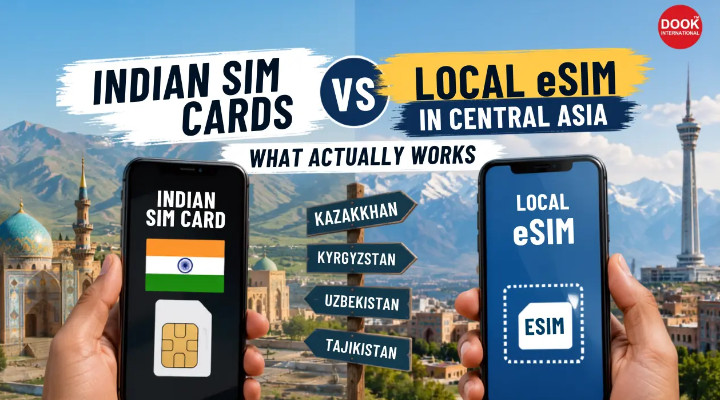
If you're planning a trip to Kazakhstan, Uzbekistan, Kyrgyzstan, or Tajikistan, connectivity is one of the first practical questions that comes up — right after visas and currency. Should you activate international roaming on your Indian SIM, or switch to a local eSIM before you land? Should you even bother with a physical local SIM card once you're there? The honest answer depends on how much data you need, how many countries you're crossing, and whether you actually need a working local phone number. This guide breaks down what each option really costs, where each one falls short, and how to think about connectivity as part of your overall trip planning — whether you're booking standalone Uzbekistan tour packages, Kazakhstan tour packages, or a longer Central Asia leg within broader international tour packages.
Why Connectivity Planning Deserves Attention Before You Book
It's easy to treat internet access as an afterthought — something you'll sort out at the airport SIM counter once you land. But Central Asia isn't quite like Southeast Asia or Europe, where local SIMs are sold at every corner store and English-language signage makes troubleshooting easy. Telecom regulations across Kazakhstan, Uzbekistan, Kyrgyzstan, and Tajikistan require passport registration for local SIM activation, network strength varies sharply between cities and rural stretches, and most travel eSIMs only connect to specific carrier networks rather than the strongest local one.
This matters more than people expect, because connectivity affects everything else on the trip — translation apps when ordering food, offline maps when your driver takes an unfamiliar route, WhatsApp calls home, and increasingly, OTP-based banking and UPI transactions if you're managing payments remotely. If you're booking Uzbekistan tour packages or Kazakhstan tour packages that involve multiple cities, your connectivity plan needs to hold up across the entire route, not just your first stop. Sorting this out before departure, rather than improvising on day one, saves a surprising amount of friction.
How Indian SIM Roaming Actually Works in Central Asia
Both Jio and Airtel support international roaming across most Central Asian countries, including Kazakhstan, Uzbekistan, Kyrgyzstan, and Tajikistan. Vi (Vodafone Idea) also offers roaming coverage in the region, though with comparatively fewer dedicated low-cost packs than Jio or Airtel.
On Jio, the most common option is the Global Pack priced around ₹1101-1102, valid for 28 days. This isn't a flat data allowance — instead, it provides a monetary value (roughly ₹930-1020) that gets consumed based on usage type: outgoing calls, calls back to India, SMS, and data, each charged at different per-unit rates depending on the country. Once that value runs out, standard Pay-As-You-Go rates apply, which can be as high as ₹2 per minute for calls and ₹2 per MB for data in many Central Asian countries. At ₹2/MB, a single hour of active Google Maps navigation or a short video call can burn through ₹200-400 in data alone, which is where roaming costs spiral quickly for travellers who don't pre-plan their usage.
Airtel offers a broadly similar IR (International Roaming) pack structure for the region, with comparable validity periods and Pay-As-You-Go fallback rates. Both networks require you to activate international roaming before departure — either through the carrier's app or by visiting a store — since roaming isn't enabled by default on most prepaid connections.
The genuine advantage of sticking with your Indian SIM is simplicity. Your phone number stays exactly the same, which matters enormously for OTP-based banking apps, UPI payments, and any service back home that sends verification codes. There's no new number to communicate to family, no eSIM installation to troubleshoot at an unfamiliar airport, and no learning curve. For a short trip — say, a 5-7 day visit to a single Central Asian city as part of focused Kazakhstan tour packages — this convenience can outweigh the higher per-MB cost.
The drawback shows up at scale. Roaming data is priced for occasional, light use — checking emails, sending a few WhatsApp messages, the occasional map lookup — not for a traveller relying on constant navigation, posting photos and reels throughout the day, or video-calling home regularly across a multi-country Central Asian circuit. If your itinerary spans Kazakhstan, Uzbekistan, and Kyrgyzstan in a single trip, as many of Dook International's international tour packages in this region do, the cumulative roaming cost across two or three weeks can end up more expensive than a local data solution.
What a Local eSIM Gives You Instead
A travel eSIM works on a fundamentally different pricing model. Instead of paying per MB as you go, you buy a fixed data bundle (or a daily-reset bundle) before you travel, install it digitally onto your phone, and it activates automatically the moment you land and connect to a supported network. No physical SIM swap, no store visit, no passport paperwork.
For Uzbekistan and Kazakhstan specifically, providers like Airalo offer price plans starting from around $4.50 for 1GB over 7 days, scaling up to roughly $22 for 10GB over 30 days, and around $34 for 20GB over 30 days. Kazakhstan eSIM pricing follows a similar range, typically between $4.50 and $32, depending on data volume and validity period. These are almost always data-only SIMs — they don't include a local phone number or SMS capability, so calls and texts typically happen over WhatsApp, Telegram, or similar VoIP apps running on the data connection rather than the regular phone dialler.
One detail that genuinely matters and that most generic guides skip over: most international travel eSIM providers in Uzbekistan — Airalo, Nomad, Saily, and similar names — connect through the same underlying network infrastructure, typically Beeline or Unitel. This network covers Tashkent, Samarkand, Bukhara, and the main Silk Road tourist corridor reasonably well. However, Uzbekistan's other local carriers — Uzmobile and Ucell, which often have stronger rural and remote-area coverage, are not accessible through any travel eSIM. You can only reach those networks with a physical local SIM card purchased and registered in-country.
Kazakhstan has a comparable setup, with Kcell, Beeline, and Tele2 operating as the major local carriers, while travel eSIM providers typically route through one specific network partner. Coverage is generally strong in Almaty, Astana, and along major highway routes, but becomes patchier in remote desert or steppe regions regardless of which provider you choose. Kyrgyzstan and Tajikistan show a similar pattern — solid coverage in Bishkek, Osh, and Dushanbe, with MegaFon being a notable network in Tajikistan, but a weaker signal in mountainous or rural stretches like parts of the Pamir Highway.
If your itinerary spans multiple Central Asian countries in one trip — which is common across Dook's broader Central Asia tour packages — a few specialised providers also offer regional multi-country eSIMs that auto-switch networks as you cross borders. This avoids the hassle of reinstalling a new eSIM every time you cross from Uzbekistan into Kyrgyzstan, or from Kazakhstan into Uzbekistan, which can otherwise mean managing three or four separate eSIM profiles across a single trip.
Physical Local SIM Cards: When They're Worth the Extra Effort
A physical local SIM card is the third option, and it's worth considering seriously if your trip includes remote or rural stretches where eSIM coverage is known to be weaker. Local SIMs from Uzmobile, Ucell, Kcell, or similar in-country carriers generally offer broader rural coverage than any international travel eSIM, simply because they're not limited to a single partner network.
The trade-off is the registration process. Central Asian telecom regulations require passport-based ID verification before a SIM can be activated, which means buying from an official carrier store at the airport or in a city centre — not an informal street vendor, where activation can be unreliable or, in rarer cases, problematic from a compliance standpoint. This process typically takes 15-30 minutes including queueing, compared to a few minutes for eSIM installation, but it's a one-time cost at the start of the trip rather than an ongoing inconvenience.
For most travellers booking standard Uzbekistan tour packages or Kazakhstan tour packages that stick to well-trodden city circuits — Tashkent, Samarkand, Bukhara, Khiva, or Almaty, Astana, Shymkent — a local SIM isn't strictly necessary, since eSIM coverage handles these routes well. It becomes genuinely useful for travellers heading into more remote regions, multi-week overland routes, or anyone planning extended stays where the lower per-GB cost of a local SIM plan starts to outweigh the registration hassle.
Indian SIM vs eSIM vs Local SIM: A Practical Comparison
Rather than a generic pros-and-cons list, here's how to think about it based on your actual trip pattern:
• Choose your Indian SIM roaming pack if: your trip is short (under a week), you need uninterrupted access to your existing number for OTPs and banking apps, you're visiting just one country in the region, or you simply want zero setup friction and are willing to pay a premium for that convenience.
• Choose a local or regional eSIM if: you're travelling for 10 days or longer, crossing multiple Central Asian countries on one trip, or expect to use heavy daily data for navigation, photo/video sharing, or video calls. The per-GB cost works out significantly cheaper than roaming Pay-As-You-Go rates once usage climbs past a certain point — usually somewhere between 1-2GB of cumulative roaming data, which most travellers cross within the first few days.
• Choose a physical local SIM if: you're heading into remote or rural areas — stretches like the Pamir Highway, Charyn Canyon, or off-the-beaten-path parts of Kyrgyzstan and Tajikistan — where local carriers offer meaningfully stronger coverage than any travel eSIM can access, or if your trip is long enough that the lower per-GB pricing justifies the one-time registration effort.
Many experienced travellers actually combine two of these — for instance, keeping the Indian SIM active (without a data pack, just for receiving OTPs and calls) while running data through an eSIM as the primary connection. This avoids the cost of roaming data entirely while keeping the home number reachable for anything urgent.
Connectivity Needs Differ by Itinerary: Uzbekistan Tour Packages vs Kazakhstan Tour Packages
It's worth noting that connectivity needs aren't identical across every Central Asia itinerary, and this is where generic advice tends to fall short. Uzbekistan tour packages typically focus on a tighter historical circuit — Tashkent, Samarkand, Bukhara, and Khiva — where Beeline/Unitel-based eSIM coverage is consistently reliable across all four cities, making a straightforward eSIM the easiest choice for most travellers.
Kazakhstan tour packages, on the other hand, often cover a wider geographic spread — Almaty, Astana, and sometimes Charyn Canyon or other natural landmarks further from major cities. Coverage along these routes can be less consistent, which makes it worth checking whether your specific eSIM provider's partner network covers the exact stops on your itinerary, rather than assuming uniform coverage across the entire country.
For travellers combining both countries — or extending into Kyrgyzstan or Tajikistan as part of a broader Central Asia circuit within Dook's international tour packages — a regional eSIM that auto-switches between country networks tends to be the most practical solution, since it removes the need to manage separate SIM profiles for each border crossing.
Practical Tips for Staying Connected During Your Trip
A few additional details that make a real difference once you're actually travelling:
• Carry a dual-SIM or eSIM-compatible phone. Most eSIM plans require either a dedicated eSIM slot or dual-SIM dual-standby support, so it's worth confirming your phone supports this before relying on an eSIM as your primary connection.
• Download offline maps before departure. Even with reliable eSIM or roaming coverage, having offline Google Maps downloaded for each city on your route is a useful backup for the inevitable patchy-signal moments, especially outside major city centres.
• Set a data usage alert. Whether on roaming or an eSIM, setting a usage alert at 80% of your data allowance avoids the unpleasant surprise of hitting a hard cap mid-trip, particularly with daily-reset eSIM plans where unused data doesn't roll over.
• Keep a small amount of roaming value active even with an eSIM. Even travellers using an eSIM as their primary data source often keep a minimal Indian SIM roaming pack active purely for receiving OTPs and emergency calls, since most eSIMs don't support SMS or calling.
• Top up eSIMs before you run low, not after. Running out of data mid-day in an unfamiliar city is far more disruptive than the small inconvenience of topping up a day early.
How This Fits Into Planning Your International Tour Packages
Connectivity is a small detail in the broader scheme of trip planning, but it's the kind of small detail that quietly shapes day-to-day experience — how easily you navigate, how connected you feel with people back home, and how much friction you encounter doing simple things like ordering food or booking a local activity. It's worth sorting out as part of your pre-trip checklist alongside visas, forex, and travel insurance, rather than leaving it for the airport on arrival day.
If you're booking through Dook International's Uzbekistan tour packages or Kazakhstan tour packages, our team typically shares country-specific connectivity recommendations as part of trip planning, since the right choice changes depending on whether your route is a single-city stay or a multi-country circuit across Tashkent, Samarkand, Almaty, and beyond. This becomes even more relevant if Central Asia is just one leg of a longer journey. Many of our international tour packages combine Uzbekistan or Kazakhstan with neighbouring Caucasus or CIS destinations, which means your connectivity plan needs to account for multiple border crossings rather than a single country's network alone.
Our Recommendation for Indian Travellers
For most Indian travellers doing a single-country Central Asia trip of a week or less, an Indian SIM roaming pack remains the simplest option, and reachability on your existing number stays intact throughout. For longer, multi-country circuits — which is how most Dook itineraries across Kazakhstan, Uzbekistan, and Kyrgyzstan are typically structured — a local or regional eSIM is the more cost-effective and practical choice, particularly for travellers relying on offline maps and constant connectivity between cities. And for anyone venturing into more remote stretches of the region, a physical local SIM, despite the slightly longer registration process, offers the most dependable coverage where it matters most.
Whichever option you choose, the goal is the same: spend less time troubleshooting connectivity and more time actually experiencing the Silk Road cities, mountain landscapes, and cultural landmarks that make Central Asia worth the trip in the first place.

 Admin
Admin 






















 Hassle-free booking and best price guaranteed
 24/7 support available
 Hand-picked tours & activities
 Free travel insurance
 sales@dooktravels.com
 +918368513675