



The short answer
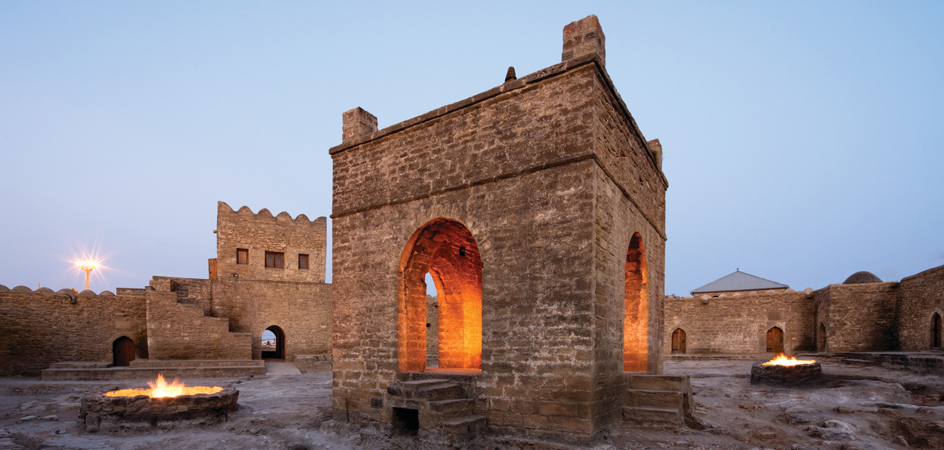
What it is: Ateshgah is a 17th to 18th-century fire temple in Surakhani, on the edge of Baku. Indian merchants and pilgrims worshipped the sacred flame here as Jwala Ji.
The Indian link: most of its inscriptions are in Sanskrit (Devanagari) and Punjabi (Gurmukhi). One above a cell door opens with an invocation to Lord Ganesha and is dated Samvat 1802, which is 1745 to 1746 CE.
Visiting: it is about 30 km from central Baku. A 2026 guide puts foreign entry at around 15 AZN, or about 20 AZN combined with Yanar Dag. Confirm before you go.
Most Indian travellers reach Baku expecting flame towers, a seafront boulevard and a medieval old city. Few expect to find "Shri Ganeshaya Namah" carved in stone above a doorway, thousands of kilometres from home. Yet that is exactly what waits at Ateshgah, a small pentagonal temple where Hindu and Sikh traders from Punjab once kept a fire burning for Jwala Ji.
This guide explains who built the temple, what the inscriptions actually say, how it connects to the Jwalamukhi temple in Himachal Pradesh, and what you need to know to visit. If you are planning a trip, you can see it on most of our Baku tours.
Ateshgah fire temple at a glance
| Location | Surakhani settlement, Absheron Peninsula, about 30 km from central Baku |
| Built | 17th and 18th centuries. The dated inscriptions run from 1668 to 1816 CE. |
| Linked to | Indian (largely Multani) merchants and pilgrims from Punjab, with Zoroastrian visitors recorded too |
| Layout | Pentagonal courtyard with 24 cells, a central fire altar, and a guest room above the gate |
| Inscriptions | 17 to 21, depending on the source. Mostly Sanskrit (Devanagari), some Punjabi (Gurmukhi), and one Persian. |
| The flame | Natural gas once fed it from below. That natural flame went out in 1969, and today it runs on piped gas. |
| Status | Museum since 1975. On UNESCO's tentative list since 1998. State Historical and Architectural Reserve since 2007. |
| Visit time | Plan for about an hour. It pairs well with Yanar Dag in the evening. |
Why is there an Indian temple in Azerbaijan?
The answer is trade. From the 17th century, merchants from Multan and other parts of Punjab ran a busy network along the Caspian Sea, trading through Baku and on to Astrakhan in Russia. Many settled in Baku for years at a time. A 1747 Russian census of the Indian community in Astrakhan found most had come from Multan.
Those traders found something familiar in Surakhani. Natural gas seeped up through the rock and burned without stopping. For Hindus, a flame that rises from the earth on its own is a form of the goddess, and the best-known example in India is the Jwalamukhi temple in Kangra. In Baku, the merchants built cells for pilgrims and ascetics around the burning vents, and the temple became a stop for sadhus walking all the way from India.
The Kangra connection
Devotees reportedly called the Kangra shrine the "smaller Jwala Ji" and Baku the "greater Jwala Ji". In 1883, the British officer Colonel C. E. Stewart met a priest at Baku who said he had earlier served at Jwala Mukhi in Punjab, according to a 2025 paper by the Vivekananda International Foundation.
What the Sanskrit and Punjabi inscriptions say
The inscriptions are carved on stone plaques above the doorways of the cells. Sources count between 17 and 21. One widely cited count is 17: 14 Hindu, 2 Sikh, and 1 Persian. A 2026 Azerbaijani heritage page lists 21, mainly in Devanagari, with some Gurmukhi and Persian.
| Inscription | What it says | Why it matters |
| Sanskrit (Devanagari) | Opens with "Shri Ganeshaya Namah", invoking Lord Ganesha, then honours Jwala Ji, the sacred flame. Dated Samvat 1802. | Shows the temple was consecrated as a Hindu shrine to Jwala Ji. |
| Punjabi (Gurmukhi) | Lines drawn from the Adi Granth, the Sikh scripture. | Confirms Sikh worshippers used the site alongside Hindus. |
| Persian | Dated 1158 AH (1745 CE), placed below a Sanskrit invocation. It records a visit by Zoroastrians from Isfahan. | Shows Zoroastrians also came here, at the same time as the Indian worshippers. |
Hindu, Sikh or Zoroastrian? What the evidence says
The name Ateshgah comes from Persian and means "home of fire", so many visitors assume it is a Zoroastrian fire temple. The evidence for the building you see today points more strongly to Hindu and Sikh use.
• The trident: a trishula sits on top of the central altar. It is a Shaiva symbol and is not associated with Zoroastrian practice.
• The cells: the rooms around the courtyard suit Hindu ascetics and pilgrims, and the complex has a cremation area. Zoroastrians traditionally do not cremate their dead.
• The scholars: the Parsi scholar Jivanji Jamshedji Modi, who studied the site, concluded in 1925 that the building was a Hindu temple rather than a Zoroastrian fire temple.
• The other side: the Persian inscription and 19th-century reports of a Parsi priest sent from Bombay show Zoroastrians did worship here. Some historians also believe an older Zoroastrian shrine stood on the site long before the present building.
The fair reading is that the present temple was built by and for Indian worshippers, on ground that may have been sacred to Zoroastrians much earlier, and that all three communities used it at different times.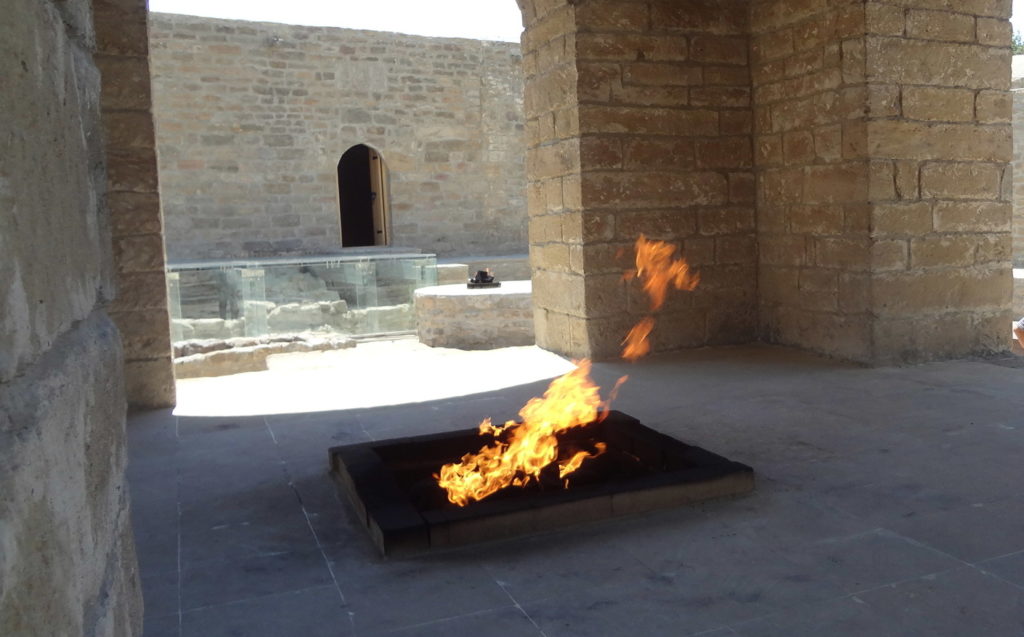
Ateshgah through travellers eyes: a timeline
| Year | What was recorded |
| 1683 | German traveller Engelbert Kaempfer notes seven vents with ever-burning fires. |
| 1745 | Sanskrit and Persian inscriptions carved, both dated to this year. |
| 1747 | English merchant Jonas Hanway describes 40 to 50 Indian devotees who marked their foreheads with saffron and revered the cow. |
| 1784 | George Forster is welcomed by Hindu ascetics and notes a long-settled Multani community in Baku. |
| 1858 | Alexandre Dumas finds three worshippers, one of whom had arrived from India six months earlier. |
| c. 1880 | The last resident priest is reported to have died, and pilgrim visits fade. |
| 1969 | Gas extraction in the area drains the natural seep, and the original flame goes out. |
| 1975 | The temple becomes a museum. |
| 1998 | Added to UNESCO's tentative list for World Heritage status. |
| 2007 | Declared a State Historical and Architectural Reserve. |
| 2018 | India's then External Affairs Minister Sushma Swaraj visits and pays respects. |
Why did the pilgrims stop coming?
Two things changed. First, the Indian trading community on the Caspian shrank in the 19th century, and with it the steady flow of pilgrims and donations. Second, Baku became one of the world's great oil centres, and large-scale extraction weakened the natural gas seeps. By around 1880 the temple had no resident priest, and in 1969 the natural flame went out altogether.
Common myths about Ateshgah
Myth vs fact
"It is a UNESCO World Heritage Site." Not quite. It has been on UNESCO's tentative list since 1998, which is a step before full listing.
"The fire has burned naturally for centuries." It did, until 1969. The flame you see now is fed by piped gas.
"It is purely a Zoroastrian temple." Zoroastrians visited, but the building, symbols, and most inscriptions are Hindu and Sikh.
"Guru Nanak visited in 1520." Some Sikh writers make this claim, but no documentary evidence has been published. The Sikh inscriptions here date from the 18th century.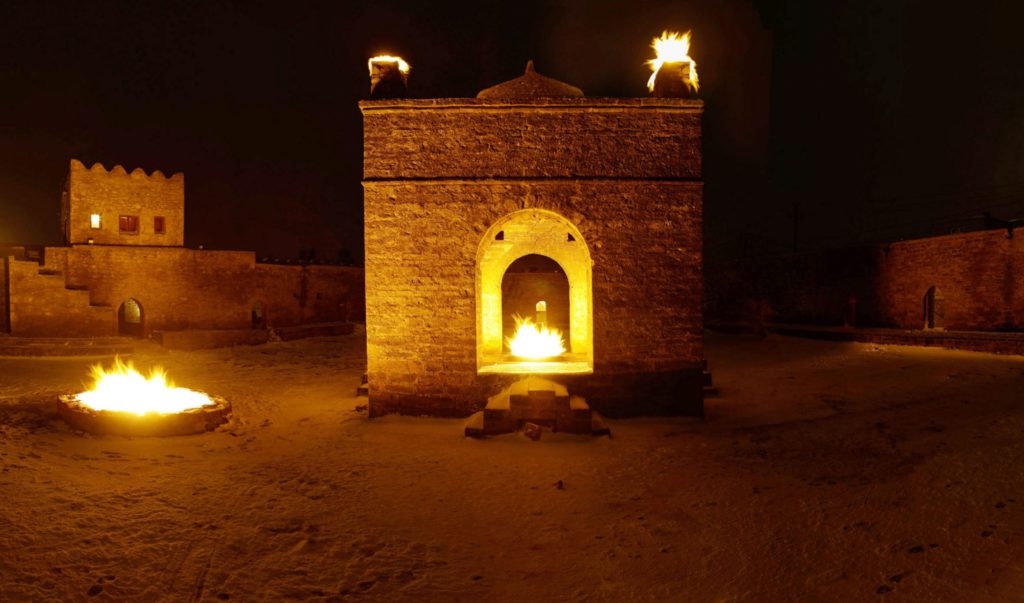
What to see inside the temple
• The central altar (chahartagh): a small domed shrine in the middle of the courtyard, with the flame burning beneath and the trident on top.
• The cells: 24 rooms around the pentagonal courtyard where pilgrims and ascetics lived. Look above each doorway for the inscriptions.
• The balakhana: the guest room above the entrance gate, used by visiting traders.
• The old gas lines and fire pits: traces of how the flame was once fed straight from the ground.
Take a photo of the Ganesha inscription and the trident together. For many Indian visitors, it is the moment the history becomes real.
Visiting Ateshgah: practical guide for Indian travellers
| Distance | About 30 km from central Baku and roughly 10 km from Heydar Aliyev Airport |
| By public transport | Metro to Koroglu station, then bus 184 to the last stop, about 35 minutes |
| By taxi or tour | The easiest option, especially if you combine it with Yanar Dag |
| Opening hours | The current iTicket listing shows 10:00 to 19:00. Check before you go. |
| Tickets | About 15 AZN for foreign adults and about 20 AZN for a combined Ateshgah and Yanar Dag ticket, according to a June 2026 guide. A 2025 guide quoted 9 AZN, so prices have risen. Book or confirm on iTicket.az. |
| Payment | Carry some cash in manat. Not every counter or cafe nearby takes cards. |
| Time needed | Plan about an hour |
| Best time of year | Spring and autumn are most comfortable. Winters are cold and windy. |
Book tickets through iTicket.az, the official ticketing platform. Indian passport holders need an e-visa for Azerbaijan, which you apply for on the official e-visa portal.
Pair it with Yanar Dag
Both sites are on the Absheron Peninsula. Visit Ateshgah in the afternoon, then head to Yanar Dag, the hillside where natural gas still burns, for sunset. Read our Yanar Dag guide for details. If you prefer to drive yourself, our self-drive guide to Baku covers rentals and rules.
How to fit Ateshgah into a Baku trip
• Use our list of things to do in Baku and 5 sights in Baku to plan the rest of your days.
• Travelling with children or parents? Our Azerbaijan family tour 2026 guide covers pace and food.
• Going beyond Baku? The Silk Route town of Sheki has its own caravanserais, once used by traders like those who built Ateshgah.
• Vegetarian? Read our Azerbaijan food guide before you go.
• See more Azerbaijan tourist attractions or browse our Azerbaijan tour packages.
See Ateshgah on your Baku trip
Our Baku itineraries include the Absheron Peninsula, so you can stand under the same doorways the Multani traders built 300 years ago. Start with the Baku 4 nights Land of Fire package or browse all Baku tours.

 Admin


























 Hassle-free booking and best price guaranteed
 24/7 support available
 Hand-picked tours & activities
 Free travel insurance
 sales@dooktravels.com
 +918368513675
