


The Przhevalsky Museum Karakol visitors come to see is a quiet memorial park, a single museum hall, and that grave. This guide covers his story, what's inside, opening hours, ticket price, and how to fit it into a 2027 Kyrgyzstan trip.
The short answer: The Przhevalsky Museum is a memorial museum and park at Pristan-Przhevalsk, about 9 km north of Karakol on Issyk-Kul's Mikhailovka Inlet. It opened in 1957 beside the grave and 1894 eagle monument of explorer Nikolai Przhevalsky (1839–1888). It is open daily, roughly 9 am to 5 pm, entry has been listed at about 120 som (≈ ₹130), and a visit takes 1–1.5 hours.
Przhevalsky Museum at a glance
| Detail | What to know |
| Location | Pristan-Przhevalsk, on the Mikhailovka Inlet of Issyk-Kul |
| Distance from Karakol | About 9 km north, 15–20 minutes by car |
| Museum opened | 29 April 1957 |
| Grave monument | Bronze eagle on granite, erected in 1894 |
| Opening hours | Daily, around 9:00–17:00 |
| Entry fee | About 120 som (≈ ₹130); confirm at the desk |
| Time needed | 1–1.5 hours |
| Labels | Mostly Russian; a guide or translation app helps |
Who was Nikolai Przhevalsky?
Nikolai Przhevalsky (1839–1888) was a Russian army officer and geographer who led four expeditions across Central and East Asia. Born near Smolensk, he mapped vast areas of Mongolia, western China, and northern Tibet that were largely blank on European maps.
| Expedition | Years | Route highlights |
| First | 1870–1873 | Across the Gobi to Beijing, the upper Yangtze and into Tibet |
| Second | 1876–1877 | East Turkestan and the Tian Shan; an attempt on Lhasa |
| Third | 1879–1880 | Hami, the Qaidam Basin and Tibet, within 260 km of Lhasa |
| Fourth | 1883–1885 | The Gobi, Alashan, the Yangtze headwaters, Hotan and Issyk-Kul |
Across these journeys, he covered more than 29,500 versts, roughly 31,500 km. He brought back about 5,000 bird specimens, more than 700 mammals and 15,000 plant specimens.
His name lives on in the wild horse he described for European science, Przewalski's horse, and in Przewalski's gazelle. He received the Royal Geographical Society's Founder's Medal in 1879.
Why is Przhevalsky buried in Karakol?
Przhevalsky arrived in Karakol in 1888 to begin his fifth expedition. He had caught typhoid, reportedly after drinking river water while hunting near Pishpek (today's Bishkek), and died in Karakol on 1 November 1888.
He asked to be buried on the shore of Issyk-Kul, and he was. A year later, Tsar Alexander III renamed the town Przhevalsk. It reverted to Karakol in 1921, became Przhevalsk again in 1939, and took back its Kyrgyz name in 1991.
What to see at the Przhevalsky Museum
The memorial complex has three parts: the museum hall, the grave and monument, and the park around them.
The museum hall
The single-storey building traces his expeditions through maps, photographs, letters, personal belongings and early editions of his books. A large wall map shows his routes across Asia. Stuffed animals and bird displays recall the specimens he collected.
The grave and eagle monument
The monument above his grave was erected in 1894 to a design by his friend A. A. Bilderling, with sculptor I. N. Schroeder. A bronze eagle with an olive branch stands on a rough granite rock, above a map of Asia. It is the most photographed spot in the complex.
The memorial park and lake view
Tree-lined paths lead from the museum to a viewpoint over the Mikhailovka Inlet. Kyrgyz linguist Hussein Karasaev was also buried here in 1998. The old Soviet-era torpedo testing site nearby is closed to visitors.
Opening hours and ticket price
The Przhevalsky Museum is open daily from about 9:00 to 17:00. Entry is listed at around 120 som (≈ ₹130) per person, and guided tours may cost extra.
Prices and hours in smaller Kyrgyz museums change without much notice. Treat these as guide figures for 2027 and carry cash in som.
How to get to the Przhevalsky Museum
From Karakol
The museum is about 9 km north of central Karakol, at Pristan-Przhevalsk. A taxi takes 15–20 minutes; ask the driver to wait or agree on a return time. Local minibuses also run to Pristan-Przhevalsk; check the current route at your guesthouse.
From Bishkek to Karakol
Karakol is about 380 km from Bishkek, usually 5–6 hours by minibus or shared taxi along the lake's north shore. Most travellers spend at least two nights in Karakol to see the town and the mountains nearby.
From India
Indian travellers fly into Manas International Airport in Bishkek, usually with a connection. Indian passport holders can apply for a Kyrgyz e-visa on the official government portal, evisa.e-gov.kg, at least a week before travel.
Best time to visit
The museum is open year-round. May to October brings mild weather and pleasant walks in the park, while summer is the busiest season around Issyk-Kul.
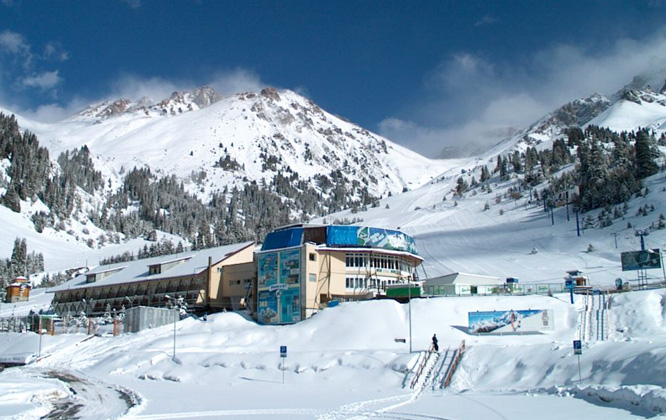
In winter, the grounds are quiet and often frosty, and the museum fits easily into a ski trip. Our guide to the Karakol ski base covers slopes, season and costs.
Tips for Indian travellers
• Hire a guide or use a translation app. Most labels are in Russian, and a guide brings the expedition stories to life.
• Carry cash in som. Card payment is not reliable at small museums.
• Ask before photographing inside. Some museums charge a small photo fee.
• Dress in layers. Karakol sits at about 1,745 m, and lakeside wind can be cold even in summer.
• Pair it with a half-day in Karakol to make the trip from town worthwhile.
Combine it with other Karakol sights
The museum fits neatly into a half-day loop of Karakol's landmarks:
1. Przhevalsky Museum (morning): start early, before tour groups arrive.
2. Holy Trinity Cathedral: a wooden Orthodox church completed in 1895 on a brick base.
3. Dungan Mosque: built between 1904 and 1910 by a Beijing architect without nails, in Chinese style.
4. Sunday animal market (if it's Sunday): an early-morning livestock market about 2 km north of the centre.
With an extra day, head 35 km to the red rocks of Jeti-Oguz. Our Issyk-Kul Lake guide covers Cholpon-Ata, Karakol and Jeti-Oguz in one route.
Plan your Karakol trip with Dook
The Przhevalsky Museum is a short stop, but it adds history and context to a trip around Issyk-Kul. A private driver lets you combine it with Karakol's cathedral, mosque, and nearby valleys in a single day.
Dook International's Kyrgyzstan tour packages include Karakol and Issyk-Kul, with e-visa guidance for Indian passport holders. Talk to our team to plan your 2027 dates.

 Admin























 Hassle-free booking and best price guaranteed
 24/7 support available
 Hand-picked tours & activities
 Free travel insurance
 sales@dooktravels.com
 +918368513675
